
Ch 01: Concepts of Motion
Knight Calc - Physics for Scientists and Engineers 5th Edition
Knight Calc5th EditionPhysics for Scientists and EngineersISBN: 9780137344796Not the one you use?Change textbook
Chapter 1, Problem 1

A jet plane lands on the deck of an aircraft carrier and quickly comes to a halt. Draw a basic motion diagram, using the s from the video, from the time the jet touches down until it stops.

Verified step by step guidance
1
Identify the initial point where the jet touches down on the aircraft carrier. This is the starting point of your motion diagram.
Mark the direction of the jet's motion as it moves along the deck. Since the jet is coming to a halt, the motion is in a straight line along the length of the deck.
Divide the motion into several intervals to show the jet slowing down. At each interval, draw a dot to represent the position of the jet at that moment. The dots should be closer together as the jet slows down, indicating a decrease in speed.
At each dot, draw an arrow pointing backwards relative to the motion of the jet. These arrows represent the deceleration force acting on the jet, primarily from the arresting wires and friction. The arrows should increase in length initially, indicating increasing deceleration, and then become shorter as the jet comes to a complete stop.
Label the final dot where the jet stops completely. This marks the end of the motion diagram.

Verified video answer for a similar problem:

This video solution was recommended by our tutors as helpful for the problem above.
Video duration:
2m
Was this helpful?

Key Concepts

Here are the essential concepts you must grasp in order to answer the question correctly.

Kinematics

Kinematics is the branch of mechanics that deals with the motion of objects without considering the forces that cause the motion. It involves concepts such as displacement, velocity, and acceleration, which are essential for analyzing the motion of the jet plane as it lands and comes to a stop. Understanding kinematics allows us to create motion diagrams that visually represent the changes in position over time.
Recommended video:
Guided course
08:25
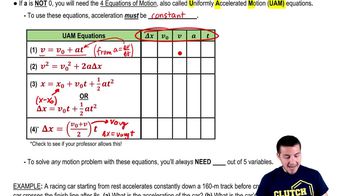
Kinematics Equations

Acceleration

Acceleration is the rate of change of velocity of an object with respect to time. In the context of the jet landing, it is crucial to understand how the plane decelerates as it touches down on the aircraft carrier. The acceleration can be negative (deceleration) as the jet reduces its speed, which is an important factor to include in the motion diagram.
Recommended video:
Guided course
05:47
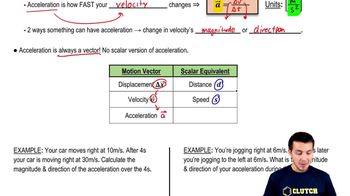
Intro to Acceleration

Free Body Diagram

A Free Body Diagram (FBD) is a graphical representation used to visualize the forces acting on an object. In the case of the jet landing, an FBD can help identify the forces such as gravity, lift, and friction that influence the plane's motion. This understanding is vital for accurately depicting the motion diagram and analyzing the dynamics involved in the landing process.
Recommended video:
Guided course
08:42
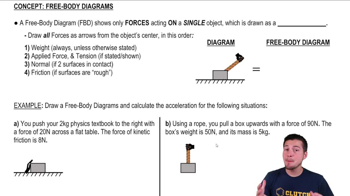
Free-Body Diagrams