Ch 01: Concepts of Motion
Knight Calc - Physics for Scientists and Engineers 5th Edition
Knight Calc5th EditionPhysics for Scientists and EngineersISBN: 9780137344796Not the one you use?Change textbook
Chapter 1, Problem 8a

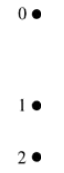
FIGURE EX1.8 shows the first three points of a motion diagram. Is the object's average speed between points 1 and 2 greater than, less than, or equal to its average speed between points 0 and 1? Explain how you can tell.

Verified step by step guidance
1
Step 1: Understand the concept of average speed. Average speed is defined as the total distance traveled divided by the total time taken. Mathematically, it can be expressed as: vavg=dt, where d is the distance and t is the time interval.
Step 2: Analyze the motion diagram provided in the image. The points labeled 0, 1, 2, 3, and 4 represent positions of the object at successive time intervals. The spacing between these points indicates the distance traveled during each time interval.
Step 3: Compare the spacing between points 0 and 1 with the spacing between points 1 and 2. If the spacing between points 1 and 2 is greater than the spacing between points 0 and 1, the object traveled a greater distance in the same time interval, resulting in a higher average speed. Conversely, if the spacing is smaller, the average speed is lower.
Step 4: Based on the image, observe that the spacing between points 1 and 2 is slightly greater than the spacing between points 0 and 1. This suggests that the object's average speed between points 1 and 2 is greater than its average speed between points 0 and 1.
Step 5: Conclude that the object's average speed between points 1 and 2 is greater than its average speed between points 0 and 1, as indicated by the increasing spacing in the motion diagram.

Verified video answer for a similar problem:

This video solution was recommended by our tutors as helpful for the problem above.
Video duration:
1m
Was this helpful?

Key Concepts

Here are the essential concepts you must grasp in order to answer the question correctly.

Average Speed

Average speed is defined as the total distance traveled divided by the total time taken. It provides a measure of how fast an object is moving over a specific interval. In the context of the motion diagram, calculating average speed between points involves determining the distance between those points and the time it took to travel that distance.
Recommended video:
Guided course
05:44
Solving Constant and Average Velocity Problems

Motion Diagram

A motion diagram visually represents an object's position at various points in time. Each point on the diagram corresponds to a specific moment, allowing for analysis of the object's movement. By examining the spacing between points, one can infer changes in speed and direction, which are crucial for understanding average speed calculations.
Recommended video:
Guided course
08:07
Work and PV Diagrams

Distance and Time Relationship

The relationship between distance and time is fundamental in kinematics. When analyzing average speed, the distance covered between two points and the time taken to cover that distance are key factors. If the distance between points increases or the time decreases, the average speed will be affected, allowing for comparisons between different segments of motion.
Recommended video:
Guided course
03:43
Relationships Between Force, Field, Energy, Potential