

Ch. 36 - The Special Theory of Relativity
Giancoli Douglas - Physics for Scientists and Engineers 5th edition
Giancoli Douglas5th editionPhysics for Scientists and EngineersISBN: 9780137488179Not the one you use?Change textbook
Chapter 35, Problem 103

What magnetic field B is needed to keep 998-GeV protons revolving in a circle of radius 1.0km? Use the relativistic mass. The proton’s “rest mass” is 0.938 GeV/c². ( 1 GeV = 10⁹ eV.) [Hint: In relativity, mᵣₑₗ v²/r = qvB is still valid in a magnetic field, where mᵣₑₗ = γm.]

Verified step by step guidance
1
Step 1: Calculate the relativistic factor, \( \gamma \), using the formula \( \gamma = \frac{1}{\sqrt{1 - \left(\frac{v}{c}\right)^2}} \). Here, \( v \) is the velocity of the proton and \( c \) is the speed of light. Since the energy of the proton is given as 998 GeV and the rest mass energy is 0.938 GeV, use the relation \( E = \gamma m_0 c^2 \) to find \( \gamma \).
Step 2: Calculate the relativistic mass, \( m_{rel} \), using the formula \( m_{rel} = \gamma m_0 \), where \( m_0 \) is the rest mass of the proton (0.938 GeV/c²).
Step 3: Use the centripetal force formula for a particle moving in a circular path under the influence of a magnetic field, which is \( \frac{m_{rel} v^2}{r} = qvB \). Here, \( r \) is the radius of the circle (1.0 km), \( q \) is the charge of the proton (approximately equal to the elementary charge, e), and \( B \) is the magnetic field.
Step 4: Rearrange the formula to solve for the magnetic field, \( B \). The equation becomes \( B = \frac{m_{rel} v}{qr} \).
Step 5: Substitute the values of \( m_{rel} \), \( v \) (which can be derived from \( \gamma \) and the total energy), \( q \), and \( r \) into the equation to find the magnetic field, \( B \).

Verified video answer for a similar problem:

This video solution was recommended by our tutors as helpful for the problem above.
Video duration:
9m
Was this helpful?

Key Concepts

Here are the essential concepts you must grasp in order to answer the question correctly.

Relativistic Mass

In the context of special relativity, the relativistic mass of an object increases with its velocity, approaching infinity as it nears the speed of light. The relativistic mass is given by the equation mᵣₑₗ = γm₀, where γ (gamma) is the Lorentz factor, defined as γ = 1 / √(1 - v²/c²). This concept is crucial for understanding how particles behave at high speeds, such as protons in a particle accelerator.
Recommended video:
Guided course
20:32
Mass Spectrometers

Lorentz Force

The Lorentz force describes the force experienced by a charged particle moving through a magnetic field. It is given by the equation F = q(v × B), where F is the force, q is the charge, v is the velocity of the particle, and B is the magnetic field. This force is essential for keeping charged particles, like protons, in circular motion within a magnetic field, as it provides the necessary centripetal force.
Recommended video:
Guided course
13:39
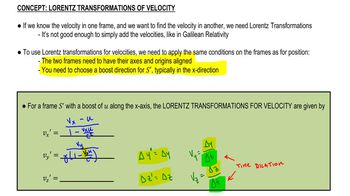
Lorentz Transformations of Velocity

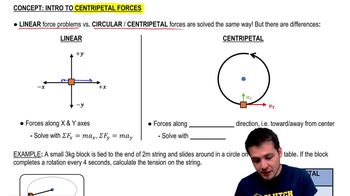
Centripetal Force

Centripetal force is the net force required to keep an object moving in a circular path, directed towards the center of the circle. For a particle of mass m moving at speed v in a circle of radius r, the centripetal force is given by F_c = mv²/r. In the case of charged particles in a magnetic field, the Lorentz force acts as the centripetal force, allowing us to relate the magnetic field strength to the radius of the circular motion.
Recommended video:
Guided course
06:48
Intro to Centripetal Forces