
Ch. 36 - The Special Theory of Relativity
Giancoli Douglas - Physics for Scientists and Engineers 5th edition
Giancoli Douglas5th editionPhysics for Scientists and EngineersISBN: 9780137488179Not the one you use?Change textbook
Chapter 35, Problem 90

For a 1.0-kg mass, make a plot of the kinetic energy as a function of speed for speeds from 0 to 0.9c, using both the classical formula ( K = 1/2 mv²) and the correct relativistic formula ( K = ( γ -1)mc²).

Verified step by step guidance
1
Identify the variables and constants: mass (m) = 1.0 kg, speed of light (c) = 3.0 x 10^8 m/s. Speed (v) will vary from 0 to 0.9c.
Use the classical kinetic energy formula: K = 1/2 mv². Substitute m = 1.0 kg and vary v from 0 to 0.9c to calculate K for each value of v.
Use the relativistic kinetic energy formula: K = (γ - 1)mc², where γ (gamma) is the Lorentz factor, calculated as γ = 1 / √(1 - v²/c²). Substitute m = 1.0 kg and c = 3.0 x 10^8 m/s, and vary v from 0 to 0.9c to calculate K for each value of v.
Plot the values of K obtained from the classical formula on the y-axis against the corresponding values of v on the x-axis. Label this plot as 'Classical Kinetic Energy'.
Plot the values of K obtained from the relativistic formula on the same graph, using a different color or line style. Label this plot as 'Relativistic Kinetic Energy'.

Verified video answer for a similar problem:

This video solution was recommended by our tutors as helpful for the problem above.
Video duration:
8m
Was this helpful?

Key Concepts

Here are the essential concepts you must grasp in order to answer the question correctly.

Kinetic Energy (Classical)

In classical mechanics, kinetic energy (K) is defined as the energy an object possesses due to its motion. It is calculated using the formula K = 1/2 mv², where m is the mass of the object and v is its velocity. This formula is valid for speeds much less than the speed of light and illustrates how kinetic energy increases with the square of the speed.
Recommended video:
Guided course
06:07
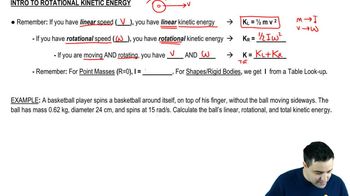
Intro to Rotational Kinetic Energy

Relativistic Kinetic Energy

In the realm of relativistic physics, when an object's speed approaches the speed of light (c), the classical kinetic energy formula becomes inadequate. The relativistic kinetic energy is given by K = (γ - 1)mc², where γ (gamma) is the Lorentz factor, defined as γ = 1 / √(1 - v²/c²). This formula accounts for the effects of relativity, showing that kinetic energy increases significantly as speed approaches c.
Recommended video:
Guided course
06:07
Intro to Rotational Kinetic Energy

Lorentz Factor

The Lorentz factor (γ) is a crucial component in the theory of relativity, representing the factor by which time, length, and relativistic mass increase as an object approaches the speed of light. It is calculated using the formula γ = 1 / √(1 - v²/c²). Understanding the Lorentz factor is essential for analyzing how velocities close to the speed of light affect the properties of moving objects, including their kinetic energy.
Recommended video:
Guided course
14:16
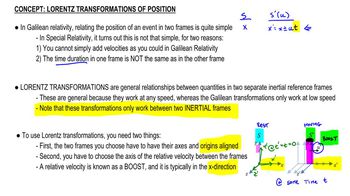
Lorentz Transformations of Position
Related Practice
Textbook Question

What magnetic field B is needed to keep 998-GeV protons revolving in a circle of radius 1.0km? Use the relativistic mass. The proton’s “rest mass” is 0.938 GeV/c². ( 1 GeV = 10⁹ eV.) [Hint: In relativity, mᵣₑₗ v²/r = qvB is still valid in a magnetic field, where mᵣₑₗ = γm.]

1
views
Textbook Question

A spaceship and its occupants have a total mass of 160,000 kg. The occupants would like to travel to a star that is 32 light-years away at a speed of 0.70c. To accelerate, the engine of the spaceship changes mass directly to energy.

(a) Estimate how much mass will be converted to energy to accelerate the spaceship to this speed.

(b) Assuming the acceleration is rapid, so the speed for the entire trip can be taken to be 0.70c, determine how long the trip will take according to the astronauts on board.

1
views
Textbook Question

Astronomers measure the distance to a particular star to be 6.0 light-years (1ly = distance light travels in 1 year). A spaceship travels from Earth to the vicinity of this star at steady speed, arriving in 3.25 years as measured by clocks on the spaceship. (a) How long does the trip take as measured by clocks in Earth’s reference frame? (b) What distance does the spaceship travel as measured in its own reference frame?

1
views
Textbook Question

Using Example 36–2 as a guide, show that for objects that move slowly in comparison to c, the length contraction formula is roughly ℓ ≈ ℓ₀ (1 - 1/2 v²/c²) . Use this approximation to find the “length shortening” ∆ℓ = ℓ₀ - ℓ of the train in Example 36–6 if the train travels at 100 km/h (rather than 0.92c).

1
views
Textbook Question

A quasar emits familiar hydrogen lines whose wavelengths are 8.5% longer than what we measure in the laboratory.

(a) Using the Doppler formula for light, estimate the speed of this quasar.

(b) What result would you obtain if you used the “classical” Doppler shift discussed in Chapter 16?

1
views
Textbook Question

A pi meson of mass mπ decays at rest into a muon (mass mμ) and a neutrino of negligible or zero mass. Show that the kinetic energy of the muon is Kμ = (mπ - mμ)² c² / (2mπ).

1
views