
Ch. 36 - The Special Theory of Relativity
Giancoli Douglas - Physics for Scientists and Engineers 5th edition
Giancoli Douglas5th editionPhysics for Scientists and EngineersISBN: 9780137488179Not the one you use?Change textbook
Chapter 35, Problem 98

Astronomers measure the distance to a particular star to be 6.0 light-years (1ly = distance light travels in 1 year). A spaceship travels from Earth to the vicinity of this star at steady speed, arriving in 3.25 years as measured by clocks on the spaceship. (a) How long does the trip take as measured by clocks in Earth’s reference frame? (b) What distance does the spaceship travel as measured in its own reference frame?

Verified step by step guidance
1
Step 1: Understand the concept of time dilation in special relativity. The time measured in the moving frame (spaceship) is shorter than the time measured in the stationary frame (Earth) due to the effects of traveling at a significant fraction of the speed of light.
Step 2: Use the time dilation formula to calculate the time taken as measured by Earth's clocks. The formula is \(t = \frac{t_0}{\sqrt{1 - v^2/c^2}}\), where \(t_0\) is the time measured in the spaceship's frame, \(v\) is the velocity of the spaceship, and \(c\) is the speed of light.
Step 3: Calculate the velocity of the spaceship using the information that the distance to the star is 6.0 light-years and the travel time in the spaceship's frame is 3.25 years. Use the formula \(v = \frac{d}{t_0}\), where \(d\) is the distance and \(t_0\) is the time in the spaceship's frame.
Step 4: Use the calculated velocity to find the Lorentz factor, \(\gamma = \frac{1}{\sqrt{1 - v^2/c^2}}\), which is used in the time dilation formula.
Step 5: Calculate the distance traveled as measured in the spaceship's own reference frame using the length contraction formula \(L = L_0 \sqrt{1 - v^2/c^2}\), where \(L_0\) is the original length (6.0 light-years) and \(L\) is the contracted length.

Verified video answer for a similar problem:

This video solution was recommended by our tutors as helpful for the problem above.
Video duration:
9m
Was this helpful?

Key Concepts

Here are the essential concepts you must grasp in order to answer the question correctly.

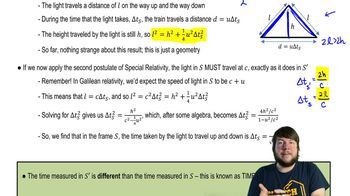
Time Dilation

Time dilation is a phenomenon predicted by Einstein's theory of relativity, where time passes at different rates for observers in different frames of reference. In this scenario, the spaceship traveling at a significant fraction of the speed of light experiences less passage of time compared to observers on Earth. This effect becomes pronounced at high velocities, leading to the discrepancy in time measurements between the spaceship and Earth.
Recommended video:
Guided course
12:57
Time Dilation

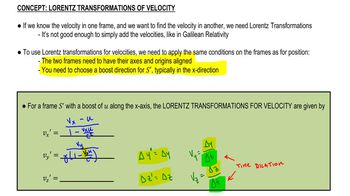
Lorentz Transformation

The Lorentz transformation equations relate the space and time coordinates of events as observed in different inertial frames. They are essential for calculating how measurements of time and distance change for observers moving relative to one another. In this problem, these transformations will help determine the time taken for the trip as measured from Earth's frame and the distance traveled in the spaceship's frame.
Recommended video:
Guided course
13:39
Lorentz Transformations of Velocity

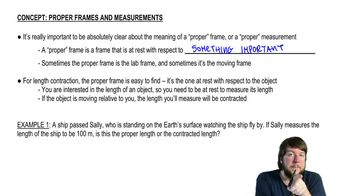
Proper Length and Proper Time

Proper length refers to the length of an object measured in the frame where the object is at rest, while proper time is the time interval measured by a clock that is at rest relative to the events being timed. In this question, the distance to the star is the proper length, and the time experienced by the spaceship is the proper time. Understanding these concepts is crucial for solving the problem as they help differentiate between measurements taken in different reference frames.
Recommended video:
Guided course
07:49
Proper Frames and Measurements