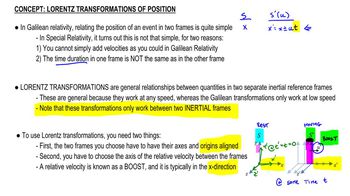
An observer in reference frame S notes that two events are separated in space by 180 m and in time by 0.80μs. How fast must reference frame S' be moving relative to S in order for an observer in S' to detect the two events as occurring at the same location in space?
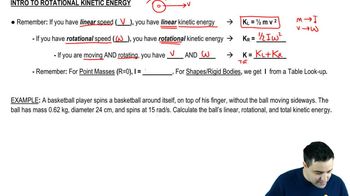
Suppose a spacecraft of mass 17,000 kg was accelerated to 0.22c.
(a) How much kinetic energy would it have?
(b) If you used the classical formula for kinetic energy, by what percentage would you be in error?
Verified step by step guidance
Verified video answer for a similar problem:
Key Concepts
Relativistic Kinetic Energy
Classical Kinetic Energy
Lorentz Factor
(III) If a particle moves in the xy plane of system S (Fig. 36–12) with speed u in a direction that makes an angle θ with the x axis, show that it makes an angle θ' in S' given by .
(III) (a) In reference frame S, a particle has momentum along the positive x axis. Show that in frame S’, which moves with speed v as in Fig. 36–12, the momentum has components
(These transformation equations hold, actually, for any direction of , as long as the motion of S' is along the x axis.) (b) Show that px, py, pz, E/c transform according to the Lorentz transformation in the same way as x, y, z, ct.
In the old West, a marshal riding on a train traveling 35.0 m/s sees a duel between two men standing on the Earth 55.0 m apart parallel to the train. The marshal’s instruments indicate that in his reference frame the two men fired simultaneously.
(a) Which of the two men, the first one the train passes (A) or the second one (B) should be arrested for firing the first shot? That is, in the gunfighter’s frame of reference, who fired first?
(b) How much earlier did he fire?
(c) Who was struck first?
Make a graph of the kinetic energy versus momentum for (a) a particle of nonzero mass, and (b) a particle with zero mass.
Show that the kinetic energy K of a particle of mass m is related to its momentum p by the equation .