Ch. 36 - The Special Theory of Relativity
Giancoli Douglas - Physics for Scientists and Engineers 5th edition
Giancoli Douglas5th editionPhysics for Scientists and EngineersISBN: 9780137488179Not the one you use?Change textbook
Chapter 35, Problem 58

Show that the kinetic energy K of a particle of mass m is related to its momentum p by the equation p=K2+2Kmc2cp=\(\frac{\sqrt{K^2+2Kmc^2}\)}{c}.

Verified step by step guidance
1
Start with the definition of kinetic energy (K) for a particle: \( K = \frac{1}{2}mv^2 \), where \( m \) is the mass of the particle and \( v \) is its velocity.
Recall the definition of momentum (p): \( p = mv \). Substitute \( v \) from the momentum equation into the kinetic energy equation.
Rearrange the kinetic energy equation to express \( v \) in terms of \( p \): \( v = \frac{p}{m} \). Substitute this expression for \( v \) into \( K = \frac{1}{2}mv^2 \).
Simplify the equation: \( K = \frac{1}{2}m\left(\frac{p}{m}\right)^2 \), which becomes \( K = \frac{p^2}{2m} \).
Rearrange the equation \( K = \frac{p^2}{2m} \) to solve for \( p \): \( p = \sqrt{2Km} \). This shows the relationship between kinetic energy and momentum.

Verified video answer for a similar problem:

This video solution was recommended by our tutors as helpful for the problem above.
Video duration:
4m
Was this helpful?

Key Concepts

Here are the essential concepts you must grasp in order to answer the question correctly.

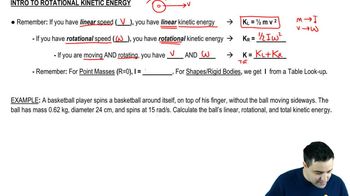
Kinetic Energy

Kinetic energy (K) is the energy that a particle possesses due to its motion. It is defined mathematically as K = (1/2)mv², where m is the mass and v is the velocity of the particle. This concept is fundamental in understanding how energy is converted and transferred in physical systems.
Recommended video:
Guided course
06:07
Intro to Rotational Kinetic Energy

Momentum

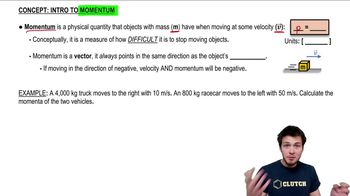
Momentum (p) is a vector quantity defined as the product of an object's mass and its velocity, expressed as p = mv. It is a key concept in physics because it is conserved in isolated systems, meaning the total momentum before and after an event remains constant. Understanding momentum is crucial for analyzing collisions and interactions between particles.
Recommended video:
Guided course
05:17
Intro to Momentum

Relativistic Effects

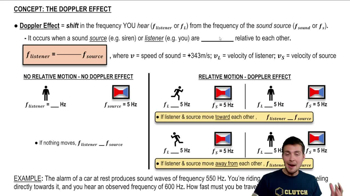
Relativistic effects become significant at speeds approaching the speed of light, affecting the relationship between kinetic energy and momentum. In relativistic physics, the equations for kinetic energy and momentum are modified to account for the increase in mass and energy as an object's speed increases. This understanding is essential for deriving the relationship between kinetic energy and momentum in high-energy physics scenarios.
Recommended video:
Guided course
07:40
The Doppler Effect
Related Practice
Textbook Question

A certain galaxy has a Doppler shift given by ƒ₀ - ƒ = 0.1015 ƒ₀. Estimate how fast it is moving away from us.

1
views

Textbook Question

Suppose a spacecraft of mass 17,000 kg was accelerated to 0.22c.

(a) How much kinetic energy would it have?

(b) If you used the classical formula for kinetic energy, by what percentage would you be in error?

1
views
Textbook Question

(III) If a particle moves in the xy plane of system S (Fig. 36–12) with speed u in a direction that makes an angle θ with the x axis, show that it makes an angle θ' in S' given by tanθ=(sinθ)1v2/c2/(cosθv/u)\(\tan\]\theta\)^{\(\prime\)}=(\(\sin\[\theta\))\(\sqrt{1-v^2/c^2}\)/(\(\cos\]\theta\)-v/u).

1
views
Textbook Question

(III) (a) In reference frame S, a particle has momentum p=pxi\(\overrightarrow{\mathbf{p}\)}=p_{x}\(\mathbf{i}\) along the positive x axis. Show that in frame S’, which moves with speed v as in Fig. 36–12, the momentum has components

px=pxvE/c21v2/c2p_{x}^{\(\prime\)}=\(\frac{px-vE/c^2}{\sqrt{1-v^2/c^2}\)}

py=pyp_{y}^{\(\prime\)}=py

pz=pzp_{z}^{\(\prime\)}=pz

E=Epxv1v2/c2.E^{\(\prime\)}=\(\frac{E-p_{x}\)v}{\(\sqrt{1-v^2/c^2}\)}.

(These transformation equations hold, actually, for any direction of p\(\overrightarrow{\mathbf{p}\)}, as long as the motion of S' is along the x axis.) (b) Show that px, py, pz, E/c transform according to the Lorentz transformation in the same way as x, y, z, ct.

1
views
Textbook Question

Make a graph of the kinetic energy versus momentum for (a) a particle of nonzero mass, and (b) a particle with zero mass.

1
views
Textbook Question

A spaceship moving toward Earth at 0.65c transmits radio signals at 95.0 MHz. At what frequency should Earth receivers be tuned?

2
views