
Ch. 36 - The Special Theory of Relativity
Giancoli Douglas - Physics for Scientists and Engineers 5th edition
Giancoli Douglas5th editionPhysics for Scientists and EngineersISBN: 9780137488179Not the one you use?Change textbook
Chapter 35, Problem 29

In the old West, a marshal riding on a train traveling 35.0 m/s sees a duel between two men standing on the Earth 55.0 m apart parallel to the train. The marshal’s instruments indicate that in his reference frame the two men fired simultaneously.
(a) Which of the two men, the first one the train passes (A) or the second one (B) should be arrested for firing the first shot? That is, in the gunfighter’s frame of reference, who fired first?
(b) How much earlier did he fire?
(c) Who was struck first?

Verified step by step guidance
1
Step 1: Recognize that this problem involves the concept of relativity of simultaneity from Einstein's theory of special relativity. Events that are simultaneous in one reference frame may not be simultaneous in another frame moving relative to the first.
Step 2: Define the reference frames. The marshal is in the train's reference frame, moving at 35.0 m/s relative to the ground. The two gunfighters (A and B) are stationary on the ground. In the marshal's frame, the two gunfighters fire simultaneously, but we need to determine the sequence of events in the gunfighters' frame.
Step 3: Use the Lorentz transformation for time to calculate the time difference between the two events in the gunfighters' frame. The formula for time transformation is: Δtground=γ(ΔttrainvΔxtrain/c2), where γ is the Lorentz factor, v is the train's velocity, Δx is the spatial separation of the events, and c is the speed of light.
Step 4: Substitute the given values into the Lorentz transformation. The spatial separation Δx in the train's frame is 55.0 m (distance between the gunfighters), and the train's velocity v is 35.0 m/s. Since the events are simultaneous in the train's frame, Δt_train = 0. Calculate the time difference Δt_ground in the gunfighters' frame.
Step 5: Analyze the result of the time difference. If Δt_ground is positive, it means gunfighter A fired first in the gunfighters' frame. If Δt_ground is negative, gunfighter B fired first. Use this information to answer part (a). For part (b), the magnitude of Δt_ground gives how much earlier the first shot was fired. For part (c), consider the relative positions of the gunfighters and the train's motion to determine who was struck first.

Verified video answer for a similar problem:

This video solution was recommended by our tutors as helpful for the problem above.
Video duration:
8m
Was this helpful?

Key Concepts

Here are the essential concepts you must grasp in order to answer the question correctly.

Relativity of Simultaneity

The relativity of simultaneity is a concept from Einstein's theory of relativity, which states that events that are simultaneous in one reference frame may not be simultaneous in another. In this scenario, the marshal on the train perceives the two gunshots as simultaneous, but due to the train's motion, the timing of the shots will differ when viewed from the gunfighters' frame of reference on the ground.
Recommended video:
Guided course
04:27
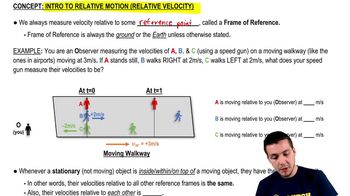
Intro to Relative Motion (Relative Velocity)

Reference Frames

A reference frame is a perspective from which measurements are made, including time and space. In this problem, there are two reference frames: the marshal's moving frame on the train and the stationary frame of the two gunfighters. Understanding how events are perceived differently in these frames is crucial for determining who fired first and the timing of the shots.
Recommended video:
Guided course
14:10
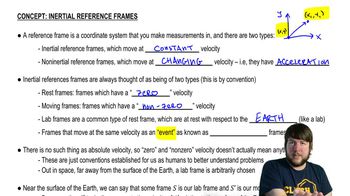
Inertial Reference Frames

Time Dilation

Time dilation is a phenomenon predicted by relativity, where time is measured to be moving slower in a moving reference frame compared to a stationary one. While this concept is more relevant for high speeds close to the speed of light, it underlines the importance of understanding how time can be perceived differently in various frames, affecting the analysis of when the shots were fired in this scenario.
Recommended video:
Guided course
12:57
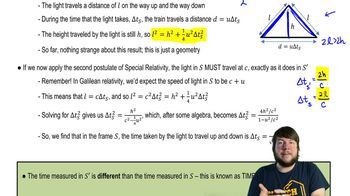
Time Dilation
Related Practice
Textbook Question

An observer in reference frame S notes that two events are separated in space by 180 m and in time by 0.80μs. How fast must reference frame S' be moving relative to S in order for an observer in S' to detect the two events as occurring at the same location in space?

1
views
Textbook Question

Suppose a spacecraft of mass 17,000 kg was accelerated to 0.22c.

(a) How much kinetic energy would it have?

(b) If you used the classical formula for kinetic energy, by what percentage would you be in error?

1
views
Textbook Question

(III) If a particle moves in the xy plane of system S (Fig. 36–12) with speed u in a direction that makes an angle θ with the x axis, show that it makes an angle θ' in S' given by tanθ=(sinθ)1v2/c2/(cosθv/u)\(\tan\]\theta\)^{\(\prime\)}=(\(\sin\[\theta\))\(\sqrt{1-v^2/c^2}\)/(\(\cos\]\theta\)-v/u).

1
views
Textbook Question

A stick of length ℓ₀, at rest in reference frame S, makes an angle θ with the x axis. In reference frame S', which moves to the right with velocity v\(\overrightarrow{v}\) = vî with respect to S, determine (a) the length l of the stick, and (b) the angle θ it makes with the x' axis.

1
views
Textbook Question

A spaceship traveling at 0.76c away from Earth fires a module with a speed of 0.85c at right angles to its own direction of travel (as seen by the spaceship). What is the speed of the module, and its direction of travel (relative to the spaceship’s direction), seen by an observer on Earth?

1
views
Textbook Question

Make a graph of the kinetic energy versus momentum for (a) a particle of nonzero mass, and (b) a particle with zero mass.

1
views