Ch. 32 - Light: Reflection and Refraction
Giancoli Douglas - Physics for Scientists and Engineers 5th edition
Giancoli Douglas5th editionPhysics for Scientists and EngineersISBN: 9780137488179Not the one you use?Change textbook
Chapter 31, Problem 2

Suppose that you want to take a photograph of yourself as you look at your image in a mirror 2.4 m away. For what distance should the camera lens be focused?

Verified step by step guidance
1
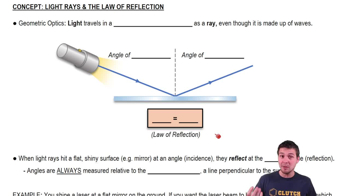
Understand the concept: When you look at your image in a flat mirror, the image appears to be the same distance behind the mirror as you are in front of it. This is due to the law of reflection, which states that the angle of incidence equals the angle of reflection.
Determine the total distance: The camera needs to focus on the distance from the camera to the mirror and then from the mirror to the image. Since the image is located behind the mirror at the same distance as the object is in front of the mirror, the total distance is the sum of these two distances.
Express the total distance mathematically: Let the distance from the camera to the mirror be \( d \), and the distance from the mirror to the image also be \( d \). The total distance the camera lens should be focused on is \( 2d \). Substituting \( d = 2.4 \, \text{m} \), the total distance becomes \( 2 \times 2.4 \, \text{m} \).
Verify the reasoning: The calculation assumes a flat mirror and neglects any effects such as lens distortion or curvature of the mirror. Ensure the mirror is flat and the distances are measured accurately.
Conclude the setup: The camera lens should be focused on the calculated total distance, which is twice the distance from the camera to the mirror. This ensures the image appears sharp in the photograph.

Key Concepts

Here are the essential concepts you must grasp in order to answer the question correctly.

Reflection

Reflection is the bouncing back of light rays when they hit a reflective surface, such as a mirror. In this scenario, the image you see in the mirror is a virtual image formed by the reflection of light. The distance from the mirror to the object (you) is equal to the distance from the mirror to the virtual image, which is crucial for determining where to focus the camera.
Recommended video:
Guided course
06:25
Law of Reflection

Virtual Image

A virtual image is an image formed by light rays that appear to diverge from a point behind a mirror. Unlike real images, virtual images cannot be projected onto a screen. In this case, the virtual image of yourself in the mirror is located 2.4 m behind the mirror, which is the same distance as you are in front of it, making it essential for the camera's focus.
Recommended video:
04:11
Example 1

Focal Length and Camera Focus

The focal length of a camera lens determines how far the lens must be from the subject to achieve a sharp image. To capture the virtual image in the mirror, the camera lens should be focused at the same distance as the virtual image's location, which is 2.4 m from the mirror. This ensures that the camera accurately captures the reflection of yourself as seen in the mirror.
Recommended video:
Guided course
10:54
Spinning on a string of variable length