Ch. 32 - Light: Reflection and Refraction
Giancoli Douglas - Physics for Scientists and Engineers 5th edition
Giancoli Douglas5th editionPhysics for Scientists and EngineersISBN: 9780137488179Not the one you use?Change textbook
Chapter 31, Problem 4

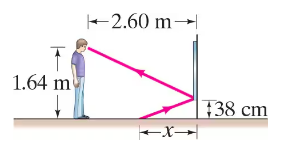
A person whose eyes are 1.64 m above the floor stands 2.60 m in front of a vertical plane mirror whose bottom edge is 38 cm above the floor, Fig. 32–48. What is the horizontal distance x, from the base of the wall supporting the mirror to the nearest point on the floor that can be seen reflected in the mirror?
A person stands 2.60 m from a mirror, with eye level at 1.64 m and the mirror's bottom edge at 38 cm above the floor.

Verified step by step guidance
1
Step 1: Understand the problem setup. The person is standing 2.60 m in front of a vertical plane mirror. The mirror's bottom edge is 38 cm (0.38 m) above the floor, and the person's eyes are 1.64 m above the floor. We need to find the horizontal distance x from the base of the wall to the nearest point on the floor that can be seen in the mirror's reflection.
Step 2: Use the law of reflection. The angle of incidence equals the angle of reflection. This means the light ray from the nearest visible point on the floor to the mirror will reflect to the person's eyes. The geometry of the situation will help us determine the horizontal distance x.
Step 3: Set up a right triangle. The vertical distance from the person's eyes to the bottom edge of the mirror is (1.64 m - 0.38 m = 1.26 m). The horizontal distance from the person to the mirror is 2.60 m. The light ray travels from the floor to the mirror and then to the person's eyes, forming a right triangle.
Step 4: Use similar triangles. The triangle formed by the light ray from the floor to the mirror and the triangle formed by the light ray from the mirror to the person's eyes are similar. The ratio of the vertical distances to the horizontal distances will be the same. Let x be the horizontal distance from the base of the wall to the nearest visible point on the floor. Then, the ratio is: \( \frac{1.26}{2.60} = \frac{0.38}{x} \).
Step 5: Solve for x. Rearrange the equation \( \frac{1.26}{2.60} = \frac{0.38}{x} \) to isolate x. Multiply both sides by x and then divide by \( \frac{1.26}{2.60} \) to find the value of x. This will give the horizontal distance from the base of the wall to the nearest visible point on the floor.

Verified video answer for a similar problem:

This video solution was recommended by our tutors as helpful for the problem above.
Video duration:
4m
Was this helpful?

Key Concepts

Here are the essential concepts you must grasp in order to answer the question correctly.

Reflection in Mirrors

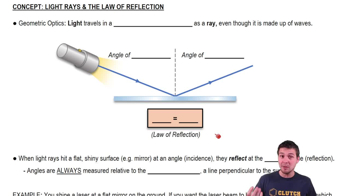
Reflection occurs when light bounces off a surface, such as a mirror. The angle of incidence, which is the angle between the incoming light ray and the normal (a line perpendicular to the surface), equals the angle of reflection. This principle is crucial for understanding how images are formed in mirrors, as it determines the path of light rays and the position of the reflected image.
Recommended video:
Guided course
06:25
Law of Reflection

Geometry of Reflection

The geometry of reflection involves understanding the spatial relationships between the observer, the mirror, and the object being viewed. In this scenario, the height of the observer's eyes and the position of the mirror's bottom edge are essential for calculating the distance to the nearest point on the floor that can be seen. This requires applying basic geometric principles to determine the angles and distances involved.
Recommended video:
Guided course
06:25
Law of Reflection

Line of Sight

The line of sight is an imaginary straight line along which an observer looks at an object. In the context of mirrors, the line of sight must be considered to determine what can be seen in the reflection. The height of the observer's eyes and the position of the mirror affect the line of sight, influencing the visible area on the floor that can be reflected back to the observer.
Recommended video:
Guided course
08:20
Electric Field Lines