

Ch. 32 - Light: Reflection and Refraction
Giancoli Douglas - Physics for Scientists and Engineers 5th edition
Giancoli Douglas5th editionPhysics for Scientists and EngineersISBN: 9780137488179Not the one you use?Change textbook
Chapter 31, Problem 94

You hold a small flat mirror 0.50 m in front of you and can see your reflection twice in that mirror because there is a full-length mirror 1.0 m behind you (Fig. 32–71). Determine the distance of each image from you.
<IMAGE>

Verified step by step guidance
1
Step 1: Understand the setup. There are two mirrors involved: a small flat mirror held 0.50 m in front of you and a full-length mirror located 1.0 m behind you. The problem involves determining the distances of the images formed by these mirrors from your position.
Step 2: Analyze the first image formed by the small flat mirror. The image distance for a flat mirror is equal to the object distance. Since the mirror is 0.50 m in front of you, the first image will appear 0.50 m behind the small mirror. Therefore, the distance of this image from you is 0.50 m.
Step 3: Analyze the second image formed by the full-length mirror. The full-length mirror is 1.0 m behind you. The image distance for a flat mirror is equal to the object distance, so the image formed by the full-length mirror will appear 1.0 m behind the mirror. Since you are 1.0 m away from the full-length mirror, the total distance of this image from you is 1.0 m + 1.0 m = 2.0 m.
Step 4: Consider the reflection of the first image in the full-length mirror. The first image formed by the small mirror (0.50 m behind it) acts as an object for the full-length mirror. The distance of this object from the full-length mirror is 1.0 m + 0.50 m = 1.5 m. The image formed by the full-length mirror will appear 1.5 m behind it. Adding the distance from you to the full-length mirror (1.0 m), the total distance of this image from you is 1.0 m + 1.5 m = 2.5 m.
Step 5: Summarize the results. The distances of the images from you are: (1) 0.50 m for the image formed by the small mirror, (2) 2.0 m for the image formed by the full-length mirror, and (3) 2.5 m for the reflection of the first image in the full-length mirror.

Verified video answer for a similar problem:

This video solution was recommended by our tutors as helpful for the problem above.
Video duration:
3m
Was this helpful?

Key Concepts

Here are the essential concepts you must grasp in order to answer the question correctly.

Reflection in Mirrors

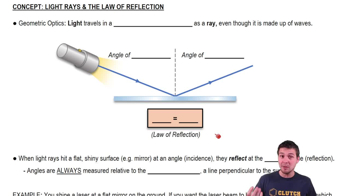
Reflection occurs when light bounces off a surface, such as a mirror. In flat mirrors, the angle of incidence equals the angle of reflection, allowing us to see images that appear to be behind the mirror. The distance of the image from the mirror is equal to the distance of the object from the mirror, creating a virtual image that appears at the same distance on the opposite side.
Recommended video:
Guided course
06:25
Law of Reflection

Image Formation

In optics, image formation refers to how light rays converge or appear to diverge from a point to create an image. For flat mirrors, the images formed are virtual, meaning they cannot be projected onto a screen. The position of the image can be calculated based on the object's distance from the mirror, following the principle that the image distance equals the object distance.
Recommended video:
05:51
Refraction at Spherical Surfaces

Multiple Reflections

Multiple reflections occur when light bounces between two or more reflective surfaces. In this scenario, the small flat mirror and the full-length mirror create a situation where the light reflects back and forth, allowing the observer to see multiple images. The distance of each image can be determined by considering the distances to each mirror and applying the principles of reflection.
Recommended video:
Guided course
06:25
Law of Reflection