Ch. 31 - Maxwell's Equations and Electromagnetic Waves
Giancoli Douglas - Physics for Scientists and Engineers 5th edition
Giancoli Douglas5th editionPhysics for Scientists and EngineersISBN: 9780137488179Not the one you use?Change textbook
Chapter 30, Problem 68

What is the maximum power level of a radio station so as to avoid electrical breakdown of air at a distance of 0.75 m from the transmitting antenna? Assume the antenna is a point source. Air breaks down in an electric field of about 3 x 10⁶ V/m.

Verified step by step guidance
1
Determine the relationship between the electric field (E) and the power radiated by the antenna (P). For a point source, the electric field at a distance r is given by: E = 30Pr2, where r is the distance from the source.
Rearrange the formula to solve for the power P. Squaring both sides and isolating P gives: P = E230 r2.
Substitute the given values into the formula. The electric field strength is 3 × 10⁶ V/m, and the distance r is 0.75 m.
Perform the substitution: P = 3 × 106230 0.752.
Simplify the expression to calculate the maximum power P. This will give the maximum power level of the radio station to avoid electrical breakdown of air.

Verified video answer for a similar problem:

This video solution was recommended by our tutors as helpful for the problem above.
Video duration:
3m
Was this helpful?

Key Concepts

Here are the essential concepts you must grasp in order to answer the question correctly.

Electric Field Strength

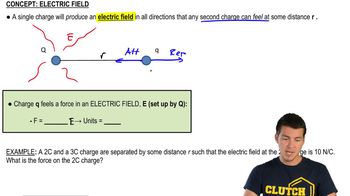
Electric field strength is defined as the force per unit charge experienced by a positive test charge placed in the field. It is measured in volts per meter (V/m) and indicates how strong the electric field is at a given point. In this context, the electric field strength generated by the radio station's antenna must be calculated to ensure it does not exceed the breakdown threshold of air, which is approximately 3 x 10⁶ V/m.
Recommended video:
Guided course
03:16
Intro to Electric Fields

Power and Intensity Relationship

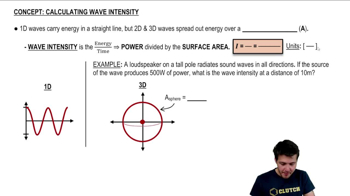
The power of a radio station is related to the intensity of the electromagnetic waves it emits. Intensity is defined as power per unit area and decreases with distance from the source. For a point source, the intensity can be calculated using the formula I = P / (4πr²), where P is the power and r is the distance from the source. This relationship is crucial for determining the maximum allowable power to avoid exceeding the electric field strength that causes air breakdown.
Recommended video:
Guided course
02:32
Wave Intensity

Antenna as a Point Source

In this scenario, the antenna is treated as a point source, meaning it radiates energy uniformly in all directions. This simplification allows for easier calculations of the electric field and intensity at a given distance. The assumption of a point source is valid when the distance from the antenna is much greater than its physical size, which is applicable in this case as the distance is 0.75 m.
Recommended video:
Guided course
08:35
Angular Momentum of a Point Mass
Related Practice
Textbook Question

Show that displacement current, ε₀ (dΦE/dt), has the SI units of amperes.

1
views

Textbook Question

How large an emf (rms) will be generated in an antenna that consists of a circular coil 2.2 cm in diameter having 280 turns of wire, when an EM wave of frequency 810 kHz transporting energy at an average rate of 1.0 x 10⁻⁴ W/m² passes through it? [Hint: You can use Eq. 29–4 (for a generator) because that equation can be applied to an observer moving with the generator’s coil as it rotates at ω = 2𝝅f with f the frequency of the magnetic field.]

Textbook Question

Imagine that a steady current I flows in a straight cylindrical wire of radius R₀ and resistivity ρ.

(a) If the current is then changed at a rate dI/dt, show that a displacement current ID exists in the wire of magnitude ε₀ρ(dI/dt).

(b) If the current in a copper wire is changed at the rate of 1.0 A/ms, determine the magnitude of ID.

(c) Determine the magnitude of the magnetic field BD created by ID at the surface of a copper wire with R₀ = 1.00 mm. Compare (as a ratio) BD with the field created at the surface of the wire by a steady current of 1.0 A.

1
views
Textbook Question

What length of antenna would be appropriate for a portable device that could receive satellite TV?

1
views
Textbook Question

Suppose a 25-kW radio station emits EM waves uniformly in all directions. What is the rms voltage induced in a 1.0-m-long vertical car antenna (c) 1.0 km away, (d) 50 km away?

2
views
Textbook Question

A powerful laser portrayed in a movie provides a 3-mm-diameter beam of green light with a power of 3 W. A good agent inside a spacecraft aims the laser beam at an enemy astronaut hovering outside. The mass of the enemy astronaut is 120 kg and the spacecraft 185,000 kg. (a) Determine the “radiation-pressure” force exerted on the enemy by the laser beam assuming her suit is perfectly reflecting. (b) If the enemy is 30 m from the spacecraft’s center of mass, estimate the gravitational force the spacecraft exerts on the enemy. (c) Which of the two forces is larger, and by what factor?

1
views