Ch. 31 - Maxwell's Equations and Electromagnetic Waves
Giancoli Douglas - Physics for Scientists and Engineers 5th edition
Giancoli Douglas5th editionPhysics for Scientists and EngineersISBN: 9780137488179Not the one you use?Change textbook
Chapter 30, Problem 76

How large an emf (rms) will be generated in an antenna that consists of a circular coil 2.2 cm in diameter having 280 turns of wire, when an EM wave of frequency 810 kHz transporting energy at an average rate of 1.0 x 10⁻⁴ W/m² passes through it? [Hint: You can use Eq. 29–4 (for a generator) because that equation can be applied to an observer moving with the generator’s coil as it rotates at ω = 2𝝅f with f the frequency of the magnetic field.]

Verified step by step guidance
1
Step 1: Identify the relevant equation for the induced emf. The rms emf (ε_rms) in a coil is given by the formula: ε_rms = (N * A * B_peak * ω) / √2, where N is the number of turns, A is the area of the coil, B_peak is the peak magnetic field, and ω is the angular frequency (ω = 2πf).
Step 2: Calculate the area (A) of the circular coil. The area of a circle is given by A = π * (r²), where r is the radius of the coil. The diameter is given as 2.2 cm, so the radius is r = 2.2 cm / 2 = 1.1 cm = 0.011 m.
Step 3: Determine the angular frequency (ω). The angular frequency is related to the frequency (f) by the formula ω = 2πf. The frequency is given as f = 810 kHz = 810,000 Hz.
Step 4: Relate the energy density of the electromagnetic wave to the peak magnetic field (B_peak). The average energy density (u_avg) of an electromagnetic wave is given by u_avg = (1/2) * ε₀ * E_peak², where E_peak is the peak electric field. The energy transported per unit area per unit time (S_avg) is related to E_peak by S_avg = c * ε₀ * E_peak² / 2. From this, solve for E_peak, and use the relationship B_peak = E_peak / c to find B_peak.
Step 5: Substitute all known values (N, A, B_peak, and ω) into the formula for ε_rms to calculate the rms emf. Ensure all units are consistent (e.g., meters, seconds, Tesla) before performing the calculation.

Verified video answer for a similar problem:

This video solution was recommended by our tutors as helpful for the problem above.
Video duration:
8m
Was this helpful?

Key Concepts

Here are the essential concepts you must grasp in order to answer the question correctly.

Electromagnetic Induction

Electromagnetic induction is the process by which a changing magnetic field within a coil of wire induces an electromotive force (emf) in the wire. This principle is fundamental to the operation of generators and antennas, where the motion of the coil in a magnetic field or the presence of an electromagnetic wave leads to the generation of voltage. The induced emf is proportional to the rate of change of the magnetic flux through the coil.
Recommended video:
Guided course
05:42
Introduction to Induction

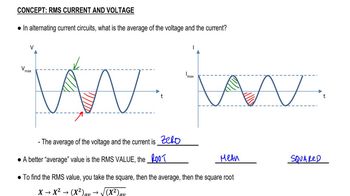
RMS Voltage

RMS (Root Mean Square) voltage is a statistical measure of the magnitude of a varying voltage or current. It represents the equivalent direct current (DC) value that would deliver the same power to a load. In the context of alternating current (AC) systems, RMS voltage is crucial for calculating power and is typically used to express the effective voltage of an AC signal, making it essential for understanding the output of devices like antennas.
Recommended video:
Guided course
07:14
RMS Current and Voltage

Frequency and Angular Frequency

Frequency refers to the number of cycles of a periodic wave that occur in one second, measured in hertz (Hz). Angular frequency, denoted as ω, is related to frequency by the equation ω = 2πf, where f is the frequency in hertz. In the context of electromagnetic waves and antennas, understanding frequency is vital for determining how the wave interacts with the coil, influencing the induced emf and the overall performance of the antenna.
Recommended video:
Guided course
05:08
Circumference, Period, and Frequency in UCM