Ch. 31 - Maxwell's Equations and Electromagnetic Waves
Giancoli Douglas - Physics for Scientists and Engineers 5th edition
Giancoli Douglas5th editionPhysics for Scientists and EngineersISBN: 9780137488179Not the one you use?Change textbook
Chapter 30, Problem 75cd

Suppose a 25-kW radio station emits EM waves uniformly in all directions. What is the rms voltage induced in a 1.0-m-long vertical car antenna (c) 1.0 km away, (d) 50 km away?

Verified step by step guidance
1
Step 1: Understand the problem. The radio station emits electromagnetic (EM) waves uniformly in all directions with a power of 25 kW. We need to calculate the root mean square (rms) voltage induced in a 1.0-m-long car antenna at two distances: 1.0 km and 50 km. The induced voltage depends on the electric field strength of the EM wave at the given distances.
Step 2: Calculate the intensity of the EM wave at a given distance. The intensity (I) of the wave is related to the power (P) emitted and the distance (r) from the source. Use the formula: I=P4πr2, where P is the power (25 kW) and r is the distance (1.0 km or 50 km).
Step 3: Relate the intensity to the electric field strength. The intensity of an EM wave is related to the electric field strength (E) by the formula: I=E2c, where c is the speed of light in a vacuum and E is the electric field strength. Rearrange this formula to solve for E: E=Ic.
Step 4: Calculate the rms voltage induced in the antenna. The rms voltage (Vrms) induced in the antenna is related to the electric field strength (E) and the length of the antenna (L) by the formula: Vrms=E×L, where L is the length of the antenna (1.0 m).
Step 5: Perform the calculations for both distances. First, calculate the intensity at 1.0 km and 50 km using Step 2. Then, use Step 3 to find the electric field strength at each distance. Finally, use Step 4 to calculate the rms voltage induced in the antenna at both distances. Ensure units are consistent throughout the calculations.

Verified video answer for a similar problem:

This video solution was recommended by our tutors as helpful for the problem above.
Video duration:
5m
Was this helpful?

Key Concepts

Here are the essential concepts you must grasp in order to answer the question correctly.

Electromagnetic Waves

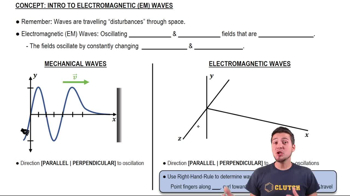
Electromagnetic (EM) waves are oscillations of electric and magnetic fields that propagate through space. They travel at the speed of light and can carry energy across distances. Understanding EM waves is crucial for analyzing how radio waves emitted by the station interact with objects like antennas.
Recommended video:
Guided course
05:22
Introduction to Electromagnetic (EM) Waves

Power and Intensity

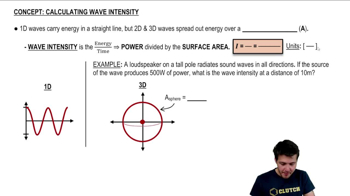
The power of a radio station, measured in watts, indicates the total energy emitted per second. Intensity, defined as power per unit area, decreases with distance from the source due to the spreading of the wavefront. This relationship is essential for calculating the voltage induced in the antenna based on its distance from the transmitter.
Recommended video:
Guided course
02:32
Wave Intensity

Induced Voltage in Antennas

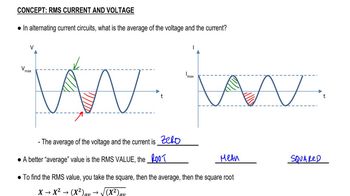
The induced voltage in an antenna is related to the electric field strength of the incoming EM waves. The root mean square (rms) voltage can be calculated using the relationship between the electric field and the antenna's length. This concept is vital for determining how effectively the antenna can convert EM wave energy into an electrical signal.
Recommended video:
Guided course
07:14
RMS Current and Voltage
Related Practice
Textbook Question

What is the maximum power level of a radio station so as to avoid electrical breakdown of air at a distance of 0.75 m from the transmitting antenna? Assume the antenna is a point source. Air breaks down in an electric field of about 3 x 10⁶ V/m.

1
views
Textbook Question

Show that displacement current, ε₀ (dΦE/dt), has the SI units of amperes.

1
views
Textbook Question

How large an emf (rms) will be generated in an antenna that consists of a circular coil 2.2 cm in diameter having 280 turns of wire, when an EM wave of frequency 810 kHz transporting energy at an average rate of 1.0 x 10⁻⁴ W/m² passes through it? [Hint: You can use Eq. 29–4 (for a generator) because that equation can be applied to an observer moving with the generator’s coil as it rotates at ω = 2𝝅f with f the frequency of the magnetic field.]

Textbook Question

Imagine that a steady current I flows in a straight cylindrical wire of radius R₀ and resistivity ρ.

(a) If the current is then changed at a rate dI/dt, show that a displacement current ID exists in the wire of magnitude ε₀ρ(dI/dt).

(b) If the current in a copper wire is changed at the rate of 1.0 A/ms, determine the magnitude of ID.

(c) Determine the magnitude of the magnetic field BD created by ID at the surface of a copper wire with R₀ = 1.00 mm. Compare (as a ratio) BD with the field created at the surface of the wire by a steady current of 1.0 A.

1
views
Textbook Question

Suppose that a right-moving EM wave overlaps with a left-moving EM wave so that, in a certain region of space, the total electric field in the y direction and magnetic field in the z direction are given by Eᵧ = E₀ sin(kx - ωt) + E₀ sin(kx + ωt) and Bz = B₀ sin(kx - ωt) - B₀ sin(kx + ωt). Determine the Poynting vector and find the x locations at which it is zero at all times.

1
views