
A space vehicle returning from the Moon enters the Earth’s atmosphere at a speed of about 42,000 km/h. Molecules (assume nitrogen) striking the nose of the vehicle with this speed correspond to what temperature? (Because of this high temperature, the nose of a space vehicle must be made of special materials; indeed, part of it does vaporize, and this is seen as a bright blaze upon reentry.)
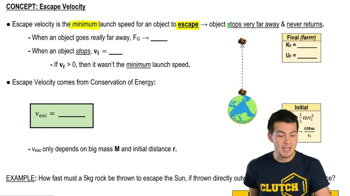
The escape speed from the Earth is 1.12 x 10⁴ m/s (Section 8–7). So a gas molecule traveling away from Earth near the outer boundary of the Earth’s atmosphere would, at this speed, be able to escape from the Earth’s gravitational field and be lost to the atmosphere. Can you explain why our atmosphere contains oxygen but not helium?
Verified step by step guidance
Verified video answer for a similar problem:
Key Concepts
Escape Velocity
Molecular Mass and Kinetic Energy
Atmospheric Retention
At about what pressure would the mean free path of air molecules be equal to the diameter of air molecules, ≈ 3 x 10⁻¹⁰ m? Assume T = 20° C.
At about what pressure would the mean free path of air molecules be 0.30 m? Assume T = 20° C.
A sauna has 7.8 m³ of air volume, and the temperature is 85°C. The air is perfectly dry. How much water (in kg) should be evaporated if we want to increase the relative humidity from 0% to 10%? (See Table 18–2.)
Estimate the time needed for a glycine molecule (see Table 18–3) to diffuse a distance of 25μm in water at 20°C if its concentration varies over that distance from 1.00 mol/m³ to 0.50 mol/m³. Compare this “speed” to its rms (thermal) speed. The molecular mass of glycine is about 75 u.
A scuba tank has a volume of 3100 cm³. For very deep dives, the tank is filled with 50% (by volume) pure oxygen and 50% pure helium. What is the ratio of the average kinetic energies of the two types of molecule?
