
Ch. 18 - Kinetic Theory of Gases
Giancoli Douglas - Physics for Scientists and Engineers 5th edition
Giancoli Douglas5th editionPhysics for Scientists and EngineersISBN: 9780137488179Not the one you use?Change textbook
Chapter 18, Problem 63b

A scuba tank has a volume of 3100 cm³. For very deep dives, the tank is filled with 50% (by volume) pure oxygen and 50% pure helium. What is the ratio of the average kinetic energies of the two types of molecule?

Verified step by step guidance
1
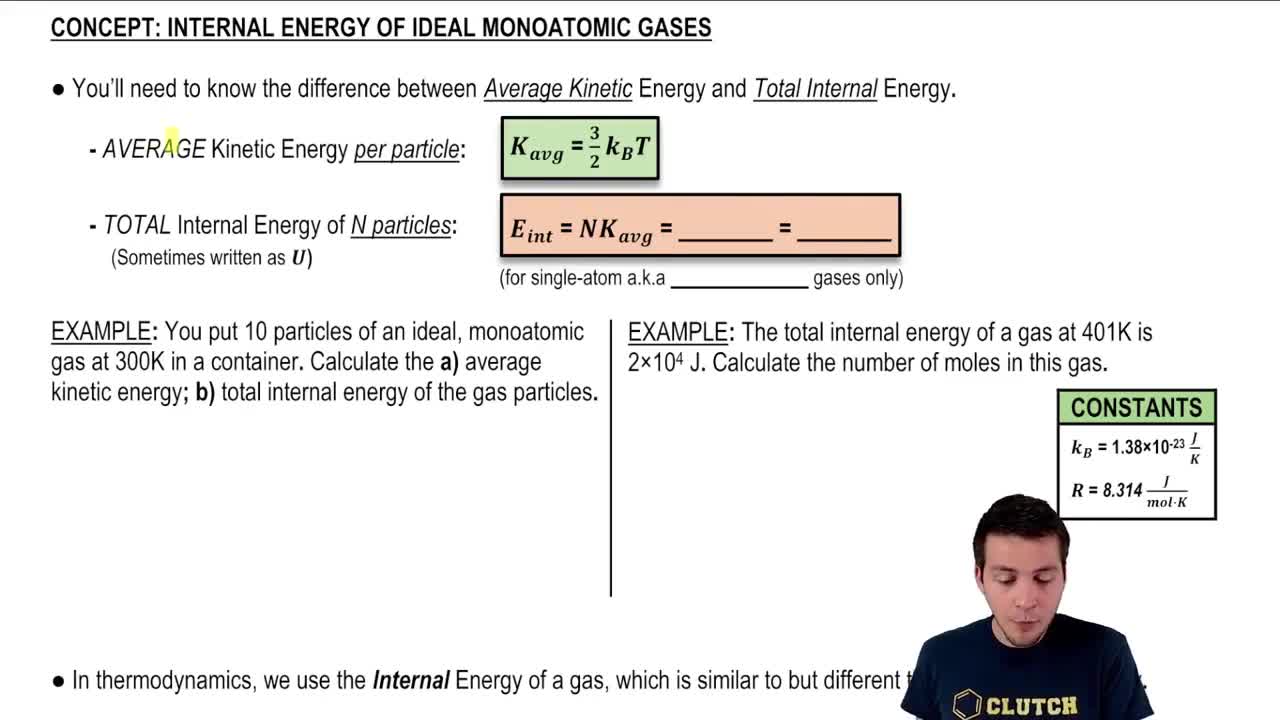
Understand the concept: The average kinetic energy of a gas molecule is determined by the temperature and is independent of the type of gas. It is given by the formula: Ekavg=32kT, where k is the Boltzmann constant and T is the absolute temperature.
Recognize that the average kinetic energy depends only on the temperature and not on the type of gas. Since both oxygen and helium are in the same tank, they are at the same temperature.
Conclude that the ratio of the average kinetic energies of the two types of molecules is 1:1 because the temperature is the same for both gases, and the formula for average kinetic energy does not depend on the molecular mass or type of gas.
Reinforce the idea: The molecular mass or type of gas affects other properties, such as the speed of the molecules, but not the average kinetic energy at a given temperature.
Summarize: The ratio of the average kinetic energies of oxygen and helium molecules in the tank is 1:1, as it is solely determined by the shared temperature of the gases.

Verified video answer for a similar problem:

This video solution was recommended by our tutors as helpful for the problem above.
Video duration:
1m
Was this helpful?

Key Concepts

Here are the essential concepts you must grasp in order to answer the question correctly.

Kinetic Energy of Gases

The average kinetic energy of gas molecules is directly related to the temperature of the gas and is given by the equation KE = (3/2)kT, where k is the Boltzmann constant and T is the absolute temperature. This means that at a given temperature, all gas molecules, regardless of their type, have the same average kinetic energy.
Recommended video:
Guided course
06:12
Internal Energy of Ideal Monoatomic Gases

Molecular Mass and Kinetic Energy

The kinetic energy of a gas molecule is also influenced by its mass. Lighter molecules, such as helium, will move faster than heavier molecules, like oxygen, at the same temperature. However, when comparing average kinetic energies, the temperature remains the key factor, leading to equal average kinetic energies for different gases at the same temperature.
Recommended video:
Guided course
01:50
Introduction to Kinetic-Molecular Theory

Ideal Gas Law

The Ideal Gas Law (PV = nRT) relates the pressure, volume, and temperature of an ideal gas. It helps in understanding the behavior of gases under various conditions. In this context, it supports the idea that the average kinetic energy of gas molecules is a function of temperature, allowing us to compare the kinetic energies of oxygen and helium in the scuba tank.
Recommended video:
Guided course
07:21
Ideal Gases and the Ideal Gas Law
Related Practice
Textbook Question

A space vehicle returning from the Moon enters the Earth’s atmosphere at a speed of about 42,000 km/h. Molecules (assume nitrogen) striking the nose of the vehicle with this speed correspond to what temperature? (Because of this high temperature, the nose of a space vehicle must be made of special materials; indeed, part of it does vaporize, and this is seen as a bright blaze upon reentry.)

1
views
Textbook Question

At about what pressure would the mean free path of air molecules be equal to the diameter of air molecules, ≈ 3 x 10⁻¹⁰ m? Assume T = 20° C.

1
views
Textbook Question

The escape speed from the Earth is 1.12 x 10⁴ m/s (Section 8–7). So a gas molecule traveling away from Earth near the outer boundary of the Earth’s atmosphere would, at this speed, be able to escape from the Earth’s gravitational field and be lost to the atmosphere. Can you explain why our atmosphere contains oxygen but not helium?

1
views
Textbook Question

A sauna has 7.8 m³ of air volume, and the temperature is 85°C. The air is perfectly dry. How much water (in kg) should be evaporated if we want to increase the relative humidity from 0% to 10%? (See Table 18–2.)

2
views
Textbook Question

Estimate the time needed for a glycine molecule (see Table 18–3) to diffuse a distance of 25μm in water at 20°C if its concentration varies over that distance from 1.00 mol/m³ to 0.50 mol/m³. Compare this “speed” to its rms (thermal) speed. The molecular mass of glycine is about 75 u.

Textbook Question

Calculate the total water vapor pressure in the air on the following day: a hot summer day, with the temperature 30°C and the relative humidity at 75%.

2
views