Ch. 18 - Kinetic Theory of Gases
Giancoli Douglas - Physics for Scientists and Engineers 5th edition
Giancoli Douglas5th editionPhysics for Scientists and EngineersISBN: 9780137488179Not the one you use?Change textbook
Chapter 18, Problem 46b

At about what pressure would the mean free path of air molecules be equal to the diameter of air molecules, ≈ 3 x 10⁻¹⁰ m? Assume T = 20° C.

Verified step by step guidance
1
The mean free path (λ) of air molecules is given by the formula: λ = (k_B T) / (√2 π d² P), where k_B is the Boltzmann constant, T is the temperature in Kelvin, d is the diameter of the air molecules, and P is the pressure.
Rearrange the formula to solve for pressure P: P = (k_B T) / (√2 π d² λ). Here, λ is given as the diameter of the air molecules, d ≈ 3 × 10⁻¹⁰ \, \(\text{m}\).
Convert the temperature from Celsius to Kelvin using the formula: T_K = T_C + 273.15. For T = 20 \, \(\degree\) \(\text{C}\), T_K = 20 + 273.15 = 293.15 \, \(\text{K}\).
Substitute the known values into the rearranged formula: P = (1.38 × 10⁻²³ \, \(\text{J/K}\) \(\times\) 293.15 \, \(\text{K}\)) / (√2 π (3 × 10⁻¹⁰ \, \(\text{m}\))² (3 × 10⁻¹⁰ \, \(\text{m}\))). Here, k_B = 1.38 × 10⁻²³ \, \(\text{J/K}\).
Simplify the expression to calculate the pressure P. Ensure all units are consistent, and the final result will be in Pascals (Pa).

Verified video answer for a similar problem:

This video solution was recommended by our tutors as helpful for the problem above.
Video duration:
6m
Was this helpful?

Key Concepts

Here are the essential concepts you must grasp in order to answer the question correctly.

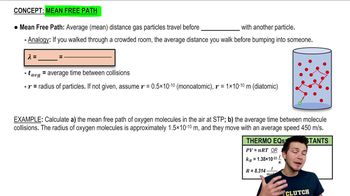
Mean Free Path

The mean free path is the average distance a molecule travels between collisions with other molecules. It is influenced by the density of the gas and the size of the molecules. In gases, as pressure increases, the mean free path decreases because molecules are closer together, leading to more frequent collisions.
Recommended video:
Guided course
08:20
Mean Free Path

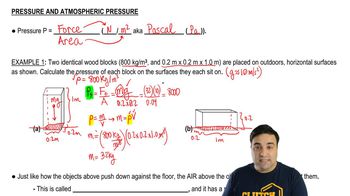
Gas Pressure

Gas pressure is the force exerted by gas molecules colliding with the walls of a container per unit area. It is directly related to the number of molecules and their kinetic energy, which is influenced by temperature. Understanding how pressure affects molecular behavior is crucial for determining conditions like the mean free path.
Recommended video:
Guided course
17:04
Pressure and Atmospheric Pressure

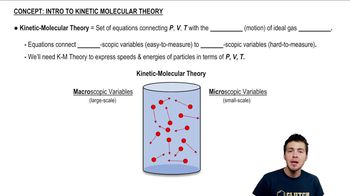
Kinetic Theory of Gases

The kinetic theory of gases describes the behavior of gases in terms of the motion of their molecules. It explains how temperature, pressure, and volume are interrelated, and provides insights into concepts like mean free path. This theory helps predict how changes in conditions affect gas properties, including molecular spacing and collision rates.
Recommended video:
Guided course
01:50
Introduction to Kinetic-Molecular Theory
Related Practice
Textbook Question

Water is in which phase when the pressure is 0.01 atm and the temperature is 90°C?

1
views

Textbook Question

Below a certain threshold pressure, the air molecules (0.3-nm diameter) within a research vacuum chamber are in the “collision-free regime,” meaning that a particular air molecule is as likely to cross the container and collide with the opposite wall as it is to collide with another air molecule. Estimate the threshold pressure for a vacuum chamber of side 1.0 m at 20°C.

1
views
Textbook Question

The escape speed from the Earth is 1.12 x 10⁴ m/s (Section 8–7). So a gas molecule traveling away from Earth near the outer boundary of the Earth’s atmosphere would, at this speed, be able to escape from the Earth’s gravitational field and be lost to the atmosphere. Can you explain why our atmosphere contains oxygen but not helium?

1
views
Textbook Question

At about what pressure would the mean free path of air molecules be 0.30 m? Assume T = 20° C.

1
views
Textbook Question

Estimate the time needed for a glycine molecule (see Table 18–3) to diffuse a distance of 25μm in water at 20°C if its concentration varies over that distance from 1.00 mol/m³ to 0.50 mol/m³. Compare this “speed” to its rms (thermal) speed. The molecular mass of glycine is about 75 u.

Textbook Question

A scuba tank has a volume of 3100 cm³. For very deep dives, the tank is filled with 50% (by volume) pure oxygen and 50% pure helium. What is the ratio of the average kinetic energies of the two types of molecule?