Textbook Question
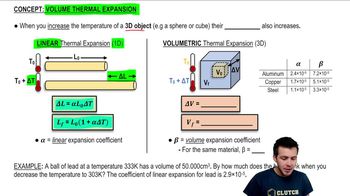
An aluminum bar has the desired length when at 12°C. How much stress is required to keep it at this length if the temperature increases to 38°C? [See Table 12–1.]
1
views

 Giancoli Douglas 5th editionCh. 17 - Temperature, Thermal Expansion, and the Ideal Gas LawProblem 25
 Verified step by step guidance
 05:21
05:21
 07:17
07:17 06:28
06:28An aluminum bar has the desired length when at 12°C. How much stress is required to keep it at this length if the temperature increases to 38°C? [See Table 12–1.]
Determine a formula for the change in surface area of a uniform solid sphere of radius r if its coefficient of linear expansion is α (assumed constant) and its temperature is changed by ∆T.
Water’s coefficient of volume expansion in the temperature range from 0°C to about 20°C is given approximately by β = α + bT + cT² , with α = - 6.43 x 10⁻⁵ (C°)⁻¹ , b = 1.70 x 10⁻⁵ (C°)⁻² , and c = -2.02 x 10⁻⁷ ((C°)⁻³. Using the formula for density from Problem 22, show that water has its greatest density at approximately 4.0°C.
A horizontal steel I-beam of a cross-sectional area of 0.041 m² is rigidly connected to two fixed vertical supports. If the beam was installed when the temperature was 25°C, is the ultimate strength of the steel exceeded?
If a fluid is contained in a long narrow vessel so it can expand in essentially one direction only, show that the effective coefficient of linear expansion α is approximately equal to the coefficient of volume expansion β.
Wine bottles are never completely filled: a small volume of air is left in the glass bottle’s cylindrically shaped neck (inner diameter d = 18.5 mm) to allow for wine’s fairly large coefficient of thermal expansion. The distance H between the surface of the liquid contents and the bottom of the cork is called the “headspace height” (Fig. 17–22), and is typically H = 1.5 cm for a 750-mL bottle filled at 20°C. Due to its alcoholic content, wine’s coefficient of volume expansion is about double that of water; in comparison, the thermal expansion of glass can be neglected. Estimate H if the bottle is kept at 10°C.