Ch. 17 - Temperature, Thermal Expansion, and the Ideal Gas Law
Giancoli Douglas - Physics for Scientists and Engineers 5th edition
Giancoli Douglas5th editionPhysics for Scientists and EngineersISBN: 9780137488179Not the one you use?Change textbook
Chapter 17, Problem 28b

A horizontal steel I-beam of a cross-sectional area of 0.041 m² is rigidly connected to two fixed vertical supports. If the beam was installed when the temperature was 25°C, is the ultimate strength of the steel exceeded?

Verified step by step guidance
1
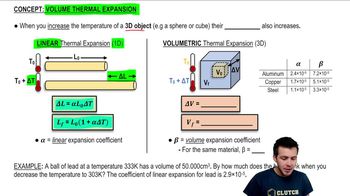
Determine the thermal expansion of the steel beam due to temperature change. Use the formula for linear thermal expansion: ΔL = LαΔT, where ΔL is the change in length, L is the original length, α is the coefficient of linear expansion for steel, and ΔT is the temperature change.
Calculate the stress induced in the beam due to the thermal expansion being constrained by the fixed supports. Use the formula: σ = EαΔT, where σ is the stress, E is the Young's modulus of steel, and α and ΔT are as defined earlier.
Compare the calculated stress to the ultimate strength of steel. The ultimate strength is a material property that represents the maximum stress the material can withstand before failure. If σ exceeds the ultimate strength, the beam will fail.
Determine whether the beam's cross-sectional area affects the stress calculation. Note that stress is independent of the cross-sectional area in this case because the formula σ = EαΔT does not include the area.
Conclude whether the ultimate strength of the steel is exceeded based on the comparison in step 3. If the stress is less than the ultimate strength, the beam remains intact; otherwise, it fails.

Verified video answer for a similar problem:

This video solution was recommended by our tutors as helpful for the problem above.
Video duration:
5m
Was this helpful?

Key Concepts

Here are the essential concepts you must grasp in order to answer the question correctly.

Thermal Expansion

Thermal expansion refers to the tendency of materials to change in size or volume in response to changes in temperature. For steel, this means that as the temperature increases, the material expands, which can create stress in structures if they are fixed at both ends. Understanding this concept is crucial for analyzing how temperature variations affect the integrity of the I-beam.
Recommended video:
Guided course
05:21
Volume Thermal Expansion

Ultimate Strength

Ultimate strength is the maximum stress that a material can withstand before failure occurs. For steel, this is a critical property that determines how much load it can bear without yielding or fracturing. In the context of the I-beam, assessing whether the ultimate strength is exceeded involves calculating the stresses induced by both the applied loads and any thermal expansion.
Recommended video:
Guided course
04:32
Dielectric Breakdown

Stress and Strain

Stress is defined as the force applied per unit area within materials, while strain is the deformation that occurs as a result of that stress. In structural analysis, it is essential to evaluate how the I-beam responds to both external loads and internal stresses due to temperature changes. Understanding the relationship between stress and strain helps in determining whether the beam will remain within safe limits under varying conditions.
Recommended video:
07:49
Ray Diagrams for Convex Mirrors