Textbook Question
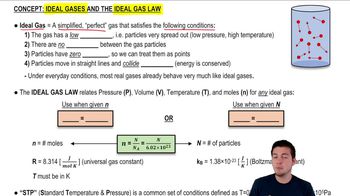
A helium-filled balloon escapes a child’s hand at sea level and 20.0°C. When it reaches an altitude of 3600 m, where the temperature is 5.0°C and the pressure only 0.64 atm, how will its volume compare to that at sea level?
1
views

 Giancoli Douglas 5th editionCh. 17 - Temperature, Thermal Expansion, and the Ideal Gas LawProblem 41
 Verified step by step guidance
 07:21
07:21
 20:32
20:32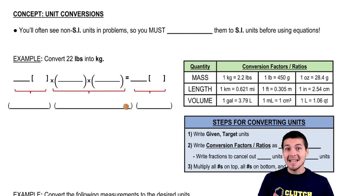 07:46
07:46A helium-filled balloon escapes a child’s hand at sea level and 20.0°C. When it reaches an altitude of 3600 m, where the temperature is 5.0°C and the pressure only 0.64 atm, how will its volume compare to that at sea level?
If 12.50 mol of helium gas is at 10.0°C and a gauge pressure of 0.350 atm, calculate
(a) the volume of the helium gas under these conditions and
(b) the temperature if the gas is compressed to precisely half the volume at a gauge pressure of 1.00 atm.
A horizontal steel I-beam of a cross-sectional area of 0.041 m² is rigidly connected to two fixed vertical supports. If the beam was installed when the temperature was 25°C, is the ultimate strength of the steel exceeded?
A storage tank at STP contains 26.5 kg of nitrogen (N₂). What is the volume of the tank?
If 59.2 L of oxygen at 18.0°C and an absolute pressure of 2.45 atm are compressed to 38.8 L and at the same time the temperature is raised to 56.0°C, what will the new pressure be?
A sealed metal container contains a gas at 30.0°C and absolute pressure 1.00 atm. To what temperature must the gas be heated for the pressure to double to 2.00 atm? (Ignore expansion of the container.)