Textbook Question
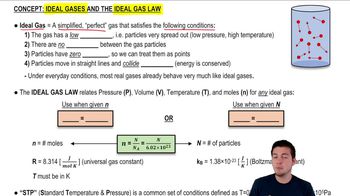
What is the pressure inside a 41.0-L container holding 105.0 kg of argon gas at 21.6°C?
1
views

 Giancoli Douglas 5th editionCh. 17 - Temperature, Thermal Expansion, and the Ideal Gas LawProblem 46
 Verified step by step guidance
 07:21
07:21
 10:20 10:20
What is the pressure inside a 41.0-L container holding 105.0 kg of argon gas at 21.6°C?
A helium balloon rises because of a buoyant force. By what percentage does the buoyant force on a helium balloon change if the temperature of the helium is increased from 15°C to 25°C while the temperature of the surrounding air is unchanged? Assume that the pressure of the helium remains constant.
An air bubble at the bottom of a lake 32.0 m deep has a volume of 1.00 cm³ . If the temperature at the bottom is 5.5°C and at the top 18.5°C, what is the radius of the bubble just before it reaches the surface?
You buy an “airtight” potato chip bag packaged at sea level, and take the chips on an airplane flight. When you take the potato chip bag out of your “carry-on” bag, you notice it has noticeably “puffed up.” Airplane cabins are typically pressurized at 0.75 atm, and assuming the temperature inside an airplane is about the same as inside a potato chip processing plant, by what percentage has the bag “puffed up” in comparison to when it was packaged?
If 59.2 L of oxygen at 18.0°C and an absolute pressure of 2.45 atm are compressed to 38.8 L and at the same time the temperature is raised to 56.0°C, what will the new pressure be?
A sealed metal container contains a gas at 30.0°C and absolute pressure 1.00 atm. To what temperature must the gas be heated for the pressure to double to 2.00 atm? (Ignore expansion of the container.)