Ch. 17 - Temperature, Thermal Expansion, and the Ideal Gas Law
Giancoli Douglas - Physics for Scientists and Engineers 5th edition
Giancoli Douglas5th editionPhysics for Scientists and EngineersISBN: 9780137488179Not the one you use?Change textbook
Chapter 17, Problem 50

You buy an “airtight” potato chip bag packaged at sea level, and take the chips on an airplane flight. When you take the potato chip bag out of your “carry-on” bag, you notice it has noticeably “puffed up.” Airplane cabins are typically pressurized at 0.75 atm, and assuming the temperature inside an airplane is about the same as inside a potato chip processing plant, by what percentage has the bag “puffed up” in comparison to when it was packaged?

Verified step by step guidance
1
Understand the problem: The potato chip bag is sealed at sea level (1 atm pressure) and taken to an airplane cabin where the pressure is reduced to 0.75 atm. Since the temperature is assumed constant, we can use Boyle's Law, which states that for a fixed amount of gas at constant temperature, the product of pressure and volume is constant: P1V1 = P2V2.
Rearrange Boyle's Law to solve for the new volume V2: V2 = (P1V1)/P2. Here, P1 is the initial pressure (1 atm), P2 is the final pressure (0.75 atm), and V1 is the initial volume.
Substitute the known values into the equation: V2 = (1 × V1)/0.75. Simplify the expression to find the ratio of the final volume to the initial volume: V2/V1 = 1.33.
Interpret the result: The ratio V2/V1 = 1.33 means that the final volume is 33% larger than the initial volume. This is the percentage by which the bag has 'puffed up.'
Conclude: The potato chip bag has increased in volume by 33% due to the reduced pressure in the airplane cabin, assuming constant temperature and no leakage of air from the bag.

Verified video answer for a similar problem:

This video solution was recommended by our tutors as helpful for the problem above.
Video duration:
6m
Was this helpful?

Key Concepts

Here are the essential concepts you must grasp in order to answer the question correctly.

Gas Laws

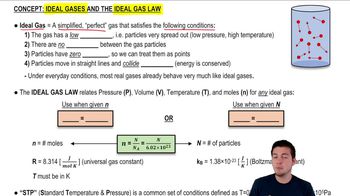
Gas laws describe the behavior of gases under various conditions of pressure, volume, and temperature. The ideal gas law, PV=nRT, relates these variables, indicating that for a fixed amount of gas, changes in pressure and volume are inversely related. Understanding these laws is crucial for analyzing how the pressure difference between sea level and the airplane cabin affects the volume of air inside the sealed potato chip bag.
Recommended video:
Guided course
07:21
Ideal Gases and the Ideal Gas Law

Pressure and Volume Relationship

According to Boyle's Law, at constant temperature, the pressure of a gas is inversely proportional to its volume. This means that if the pressure decreases, the volume must increase, assuming the amount of gas remains constant. In the context of the potato chip bag, the lower pressure in the airplane cabin compared to sea level causes the air inside the bag to expand, leading to the 'puffed up' appearance.
Recommended video:
Guided course
17:04
Pressure and Atmospheric Pressure

Atmospheric Pressure

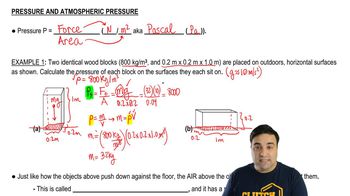
Atmospheric pressure is the force exerted by the weight of air above a given point. At sea level, this pressure is approximately 1 atm, while in an airplane cabin, it is typically around 0.75 atm. This difference in atmospheric pressure is key to understanding why the potato chip bag appears puffed up when taken to a lower pressure environment, as the air inside the bag expands to equalize the pressure difference.
Recommended video:
Guided course
17:04
Pressure and Atmospheric Pressure