Ch. 17 - Temperature, Thermal Expansion, and the Ideal Gas Law
Giancoli Douglas - Physics for Scientists and Engineers 5th edition
Giancoli Douglas5th editionPhysics for Scientists and EngineersISBN: 9780137488179Not the one you use?Change textbook
Chapter 17, Problem 23a

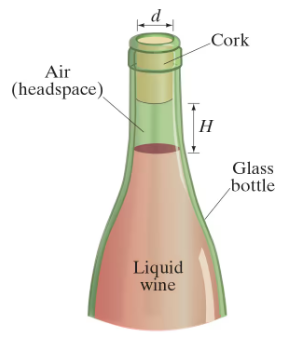
Wine bottles are never completely filled: a small volume of air is left in the glass bottle’s cylindrically shaped neck (inner diameter d = 18.5 mm) to allow for wine’s fairly large coefficient of thermal expansion. The distance H between the surface of the liquid contents and the bottom of the cork is called the “headspace height” (Fig. 17–22), and is typically H = 1.5 cm for a 750-mL bottle filled at 20°C. Due to its alcoholic content, wine’s coefficient of volume expansion is about double that of water; in comparison, the thermal expansion of glass can be neglected. Estimate H if the bottle is kept at 10°C.
Diagram of a wine bottle showing headspace height (H), air, cork, and liquid wine, with dimensions labeled.

Verified step by step guidance
1
Step 1: Understand the problem. The wine bottle has a headspace height (H) of 1.5 cm at 20°C. When the temperature changes to 10°C, the wine will contract due to its coefficient of volume expansion. We need to calculate the new headspace height (H) at 10°C.
Step 2: Recall the formula for volume expansion. The change in volume (ΔV) of a liquid due to temperature change is given by: ΔV = β * V₀ * ΔT, where β is the coefficient of volume expansion, V₀ is the initial volume, and ΔT is the temperature change.
Step 3: Calculate the change in volume of the wine. Use the given coefficient of volume expansion for wine (approximately double that of water, β ≈ 2 * 210 × 10⁻⁶ /°C), the initial volume of the wine (V₀ = 750 mL), and the temperature change (ΔT = 10°C - 20°C = -10°C).
Step 4: Relate the change in volume to the change in headspace height. The neck of the bottle is cylindrical, so the change in volume (ΔV) can be expressed as ΔV = A * ΔH, where A is the cross-sectional area of the neck (A = π * (d/2)²) and ΔH is the change in headspace height. Solve for ΔH = ΔV / A.
Step 5: Calculate the new headspace height. The new headspace height (H_new) is the original headspace height (H = 1.5 cm) plus the change in headspace height (ΔH). Substitute the values to find H_new.

Verified video answer for a similar problem:

This video solution was recommended by our tutors as helpful for the problem above.
Video duration:
7m
Was this helpful?

Key Concepts

Here are the essential concepts you must grasp in order to answer the question correctly.

Thermal Expansion

Thermal expansion refers to the tendency of matter to change its shape, area, and volume in response to a change in temperature. For liquids, this is quantified by the coefficient of volume expansion, which indicates how much a unit volume of liquid expands per degree change in temperature. In the context of wine, its coefficient of volume expansion is significant because it affects the headspace height in the bottle as temperature changes.
Recommended video:
Guided course
05:21
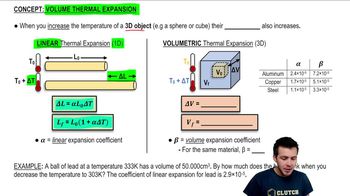
Volume Thermal Expansion

Headspace Height

Headspace height is the vertical distance between the surface of a liquid and the bottom of the closure (cork) in a container. In wine bottles, this space is crucial for accommodating the expansion of the liquid due to temperature changes, preventing overflow and maintaining the integrity of the seal. The typical headspace height for a 750-mL wine bottle is about 1.5 cm at 20°C, which can vary with temperature fluctuations.
Recommended video:
Guided course
08:17
Height of a Roof

Coefficient of Volume Expansion

The coefficient of volume expansion is a material property that quantifies how much a substance's volume changes with temperature. For wine, this coefficient is approximately double that of water, meaning it expands more significantly when heated. Understanding this concept is essential for estimating changes in headspace height when the temperature of the wine bottle is altered, such as cooling it to 10°C.
Recommended video:
Guided course
05:21
Volume Thermal Expansion
Related Practice
Textbook Question

A brass plug is to be placed in a ring made of iron. At 15°C, the diameter of the plug is 8.756 cm and that of the inside of the ring is 8.742 cm. They must both be brought to what common temperature in order to fit?

1
views

Textbook Question

It is observed that 55.50 mL of water at 20°C completely fills a container to the brim. When the container and the water are heated to 60°C, 0.35 g of water is lost.

(a) What is the coefficient of volume expansion of the container?

(b) What is the most likely material of the container? Density of water at 60°C is 0.98324 g/mL.

1
views
Textbook Question

Determine a formula for the change in surface area of a uniform solid sphere of radius r if its coefficient of linear expansion is α (assumed constant) and its temperature is changed by ∆T.

2
views
Textbook Question

Water’s coefficient of volume expansion in the temperature range from 0°C to about 20°C is given approximately by β = α + bT + cT² , with α = - 6.43 x 10⁻⁵ (C°)⁻¹ , b = 1.70 x 10⁻⁵ (C°)⁻² , and c = -2.02 x 10⁻⁷ ((C°)⁻³. Using the formula for density from Problem 22, show that water has its greatest density at approximately 4.0°C.

1
views
Textbook Question

The pendulum in a grandfather clock is made of brass and keeps perfect time at 17°C. How much time is gained or lost in a year if the clock is kept at 26°C? (Assume the frequency dependence on length for a simple pendulum applies; see Chapter 14.)

1
views
Textbook Question

If a fluid is contained in a long narrow vessel so it can expand in essentially one direction only, show that the effective coefficient of linear expansion α is approximately equal to the coefficient of volume expansion β.