
Ch. 17 - Temperature, Thermal Expansion, and the Ideal Gas Law
Giancoli Douglas - Physics for Scientists and Engineers 5th edition
Giancoli Douglas5th editionPhysics for Scientists and EngineersISBN: 9780137488179Not the one you use?Change textbook
Chapter 17, Problem 20

A brass plug is to be placed in a ring made of iron. At 15°C, the diameter of the plug is 8.756 cm and that of the inside of the ring is 8.742 cm. They must both be brought to what common temperature in order to fit?

Verified step by step guidance
1
Determine the formula for linear expansion: The change in length (or diameter in this case) due to thermal expansion is given by \( \Delta L = \alpha L_0 \Delta T \), where \( \alpha \) is the coefficient of linear expansion, \( L_0 \) is the initial length (or diameter), and \( \Delta T \) is the change in temperature.
Write the condition for the plug to fit into the ring: The diameters of the brass plug and the iron ring must be equal at the final temperature. This means \( D_{\text{plug}} + \Delta D_{\text{plug}} = D_{\text{ring}} + \Delta D_{\text{ring}} \), where \( \Delta D \) represents the change in diameter for each material.
Substitute the linear expansion formula into the condition: \( D_{\text{plug}} + \alpha_{\text{brass}} D_{\text{plug}} \Delta T = D_{\text{ring}} + \alpha_{\text{iron}} D_{\text{ring}} \Delta T \). Rearrange this equation to isolate \( \Delta T \), the change in temperature.
Plug in the known values: \( D_{\text{plug}} = 8.756 \ \text{cm} \), \( D_{\text{ring}} = 8.742 \ \text{cm} \), \( \alpha_{\text{brass}} = 19 \times 10^{-6} \ \text{°C}^{-1} \), and \( \alpha_{\text{iron}} = 12 \times 10^{-6} \ \text{°C}^{-1} \). Solve for \( \Delta T \).
Finally, calculate the common temperature: Add \( \Delta T \) to the initial temperature of 15°C to find the final temperature at which the plug and ring will fit together.

Verified video answer for a similar problem:

This video solution was recommended by our tutors as helpful for the problem above.
Video duration:
10m
Was this helpful?

Key Concepts

Here are the essential concepts you must grasp in order to answer the question correctly.

Thermal Expansion

Thermal expansion refers to the tendency of materials to change their dimensions in response to temperature changes. Most materials expand when heated and contract when cooled. This phenomenon is quantified by the coefficient of linear expansion, which indicates how much a material's length changes per degree of temperature change. Understanding thermal expansion is crucial for predicting how the brass plug and iron ring will behave as their temperatures change.
Recommended video:
Guided course
05:21
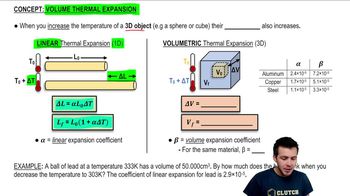
Volume Thermal Expansion

Coefficient of Linear Expansion

The coefficient of linear expansion is a material-specific value that quantifies how much a unit length of a material expands per degree of temperature increase. For example, brass and iron have different coefficients, meaning they will expand at different rates when heated. This concept is essential for calculating the temperature change required for the plug to fit into the ring, as it allows for the comparison of the expansion of both materials.
Recommended video:
Guided course
07:31
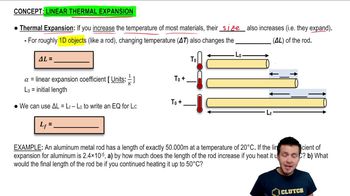
Linear Thermal Expansion

Temperature and Material Properties

Temperature significantly affects the physical properties of materials, including their dimensions. As temperature increases, the kinetic energy of the atoms in a material increases, leading to greater separation between them and thus expansion. In this problem, determining the common temperature at which both the brass plug and iron ring can fit together requires an understanding of how each material's properties change with temperature.
Recommended video:
Guided course
04:54
Introduction To Temperature Scales
Related Practice
Textbook Question

It is observed that 55.50 mL of water at 20°C completely fills a container to the brim. When the container and the water are heated to 60°C, 0.35 g of water is lost.

(a) What is the coefficient of volume expansion of the container?

(b) What is the most likely material of the container? Density of water at 60°C is 0.98324 g/mL.

1
views
Textbook Question

A glass is filled to the brim with 450.0 mL of water, all at 100.0°C. If the temperature of glass and water is decreased to 20.0°C, how much water could be added to the glass?

2
views
Textbook Question

A uniform rectangular plate of length ℓ and width ω has a coefficient of linear expansion α. Show that, if we neglect very small quantities, the change in area of the plate due to a temperature change ∆T is ∆A = 2αℓω ∆T. See Fig. 17–21.

Textbook Question

Determine a formula for the change in surface area of a uniform solid sphere of radius r if its coefficient of linear expansion is α (assumed constant) and its temperature is changed by ∆T.

2
views
Textbook Question

If a fluid is contained in a long narrow vessel so it can expand in essentially one direction only, show that the effective coefficient of linear expansion α is approximately equal to the coefficient of volume expansion β.

Textbook Question

Wine bottles are never completely filled: a small volume of air is left in the glass bottle’s cylindrically shaped neck (inner diameter d = 18.5 mm) to allow for wine’s fairly large coefficient of thermal expansion. The distance H between the surface of the liquid contents and the bottom of the cork is called the “headspace height” (Fig. 17–22), and is typically H = 1.5 cm for a 750-mL bottle filled at 20°C. Due to its alcoholic content, wine’s coefficient of volume expansion is about double that of water; in comparison, the thermal expansion of glass can be neglected. Estimate H if the bottle is kept at 10°C.

2
views