Ch. 17 - Temperature, Thermal Expansion, and the Ideal Gas Law
Giancoli Douglas - Physics for Scientists and Engineers 5th edition
Giancoli Douglas5th editionPhysics for Scientists and EngineersISBN: 9780137488179Not the one you use?Change textbook
Chapter 17, Problem 17

A glass is filled to the brim with 450.0 mL of water, all at 100.0°C. If the temperature of glass and water is decreased to 20.0°C, how much water could be added to the glass?

Verified step by step guidance
1
Determine the volume contraction of the water as it cools from 100.0°C to 20.0°C. Use the formula for volume expansion/contraction: ΔV = βV0ΔT, where β is the coefficient of volume expansion for water, V0 is the initial volume, and ΔT is the temperature change.
Calculate the volume contraction of the glass itself as it cools from 100.0°C to 20.0°C. Use the same formula for volume expansion/contraction: ΔV = βV0ΔT, but this time use the coefficient of volume expansion for glass.
Subtract the volume contraction of the glass from the volume contraction of the water. This will give the net change in volume available for additional water.
Convert the net volume change into milliliters (if necessary) to determine how much additional water can be added to the glass.
Summarize the result by stating that the additional water that can be added is equal to the net volume change calculated in the previous step.

Verified video answer for a similar problem:

This video solution was recommended by our tutors as helpful for the problem above.
Video duration:
3m
Was this helpful?

Key Concepts

Here are the essential concepts you must grasp in order to answer the question correctly.

Thermal Expansion

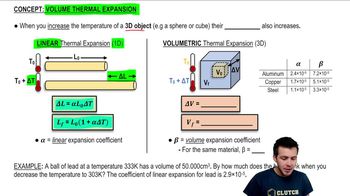
Thermal expansion refers to the increase in volume of materials as they are heated. In this scenario, both the glass and water will contract as they cool from 100.0°C to 20.0°C. Understanding how the volume of water and the glass changes with temperature is crucial for determining how much additional water can be added.
Recommended video:
Guided course
05:21
Volume Thermal Expansion

Volume Measurement

Volume measurement is the quantification of the three-dimensional space an object occupies. In this question, the initial volume of water is 450.0 mL. As the temperature decreases, the volume of both the water and the glass will change, affecting how much more water can fit into the glass without overflowing.
Recommended video:
Guided course
05:21
Volume Thermal Expansion

Density and Temperature Relationship

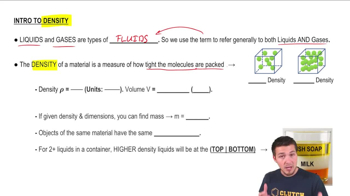
Density is defined as mass per unit volume and is affected by temperature changes. As the temperature of water decreases, its density increases, meaning that the same mass of water occupies a smaller volume. This relationship is essential for calculating how much additional water can be added to the glass after cooling.
Recommended video:
Guided course
8:13
Intro to Density
Related Practice
Textbook Question

A brass plug is to be placed in a ring made of iron. At 15°C, the diameter of the plug is 8.756 cm and that of the inside of the ring is 8.742 cm. They must both be brought to what common temperature in order to fit?

1
views

Textbook Question

It is observed that 55.50 mL of water at 20°C completely fills a container to the brim. When the container and the water are heated to 60°C, 0.35 g of water is lost.

(a) What is the coefficient of volume expansion of the container?

(b) What is the most likely material of the container? Density of water at 60°C is 0.98324 g/mL.

1
views
Textbook Question

A uniform rectangular plate of length ℓ and width ω has a coefficient of linear expansion α. Show that, if we neglect very small quantities, the change in area of the plate due to a temperature change ∆T is ∆A = 2αℓω ∆T. See Fig. 17–21.

Textbook Question

At a given latitude, ocean water in the so-called mixed layer (from the surface to a depth of about 50 m) is at approximately the same temperature due to the mixing action of waves. Assume that because of global warming, the temperature of the mixed layer is everywhere increased by 0.5°C, while the temperature of the deeper portions of the ocean remains unchanged. Estimate the resulting rise in sea level. The ocean covers about 70% of the Earth’s surface.

1
views
Textbook Question

An aluminum sphere is 8.75 cm in diameter. What will be its % change in volume if it is heated from 30°C to 140°C?

1
views
Textbook Question

If a fluid is contained in a long narrow vessel so it can expand in essentially one direction only, show that the effective coefficient of linear expansion α is approximately equal to the coefficient of volume expansion β.