Textbook Question
Show that the bulk modulus (Section 12–5) for an ideal gas held at constant temperature is B = P, where P is the pressure.
1
views

 Giancoli Douglas 5th editionCh. 17 - Temperature, Thermal Expansion, and the Ideal Gas LawProblem 75
 Verified step by step guidance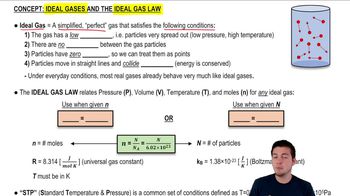
 07:21
07:21
 01:50
01:50 04:27
04:27Show that the bulk modulus (Section 12–5) for an ideal gas held at constant temperature is B = P, where P is the pressure.
A precise steel tape measure has been calibrated at 14°C. At 37°C, what will be the percentage error?
Assume that in an alternate universe, the laws of physics are very different from ours and that “ideal” gases behave as follows: At constant pressure, the volume varies directly with the 2/3 power of the temperature.
Assume that in an alternate universe, the laws of physics are very different from ours and that “ideal” gases behave as follows: At 273.15 K and 1.00 atm pressure, 1.00 mole of an ideal gas is found to occupy 22.4 L. Obtain the form of the ideal gas law in this alternate universe, including the value of the gas constant R.
Use the ideal gas law to show that, for an ideal gas at constant pressure, the coefficient of volume expansion is equal to β = 1/ T, where T is the kelvin temperature. Compare to Table 17–1 for gases at T = 293 K.
Assume that in an alternate universe, the laws of physics are very different from ours and that “ideal” gases behave as follows: At constant temperature, pressure is inversely proportional to the square of the volume.