Ch. 17 - Temperature, Thermal Expansion, and the Ideal Gas Law
Giancoli Douglas - Physics for Scientists and Engineers 5th edition
Giancoli Douglas5th editionPhysics for Scientists and EngineersISBN: 9780137488179Not the one you use?Change textbook
Chapter 17, Problem 72a

Use the ideal gas law to show that, for an ideal gas at constant pressure, the coefficient of volume expansion is equal to β = 1/ T, where T is the kelvin temperature. Compare to Table 17–1 for gases at T = 293 K.

Verified step by step guidance
1
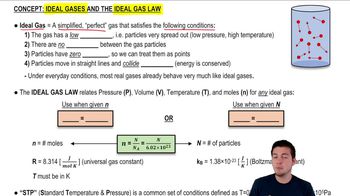
Start by recalling the ideal gas law, which is expressed as: PV=nRT, where P is pressure, V is volume, n is the number of moles, R is the gas constant, and T is the temperature in kelvin.
Since the problem specifies constant pressure, isolate the volume V in the ideal gas law: V=nRT. This shows that volume is directly proportional to temperature at constant pressure.
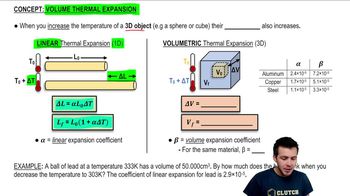
The coefficient of volume expansion β is defined as: β=VT÷V. Substitute the expression for V from the ideal gas law into this definition.
Differentiate V=nRT with respect to T. The derivative is: VT=nR. Substitute this result into the formula for β.
Simplify the expression for β: β=nRV=1T. This shows that the coefficient of volume expansion for an ideal gas at constant pressure is β=1T, as required.

Key Concepts

Here are the essential concepts you must grasp in order to answer the question correctly.

Ideal Gas Law

The ideal gas law is a fundamental equation in thermodynamics that relates the pressure (P), volume (V), and temperature (T) of an ideal gas through the equation PV = nRT, where n is the number of moles and R is the ideal gas constant. This law assumes that gas particles do not interact and occupy no volume, making it a useful approximation for many gases under standard conditions.
Recommended video:
Guided course
07:21
Ideal Gases and the Ideal Gas Law

Coefficient of Volume Expansion

The coefficient of volume expansion (β) quantifies how much a substance's volume changes with temperature. For gases, it is defined as the fractional change in volume per degree change in temperature, typically expressed in units of 1/K. At constant pressure, this coefficient indicates how gases expand when heated, which is crucial for understanding thermal properties in various applications.
Recommended video:
Guided course
05:21
Volume Thermal Expansion

Thermal Equilibrium and Temperature

Thermal equilibrium occurs when two systems reach the same temperature and no heat flows between them. Temperature, measured in Kelvin for thermodynamic calculations, is a measure of the average kinetic energy of particles in a substance. In the context of the ideal gas law and volume expansion, understanding temperature's role is essential for predicting how gas behavior changes with heat input.
Recommended video:
Guided course
09:55
Calculating Equilibrium Temperature in Calorimetry Problems with Phase Changes