Textbook Question
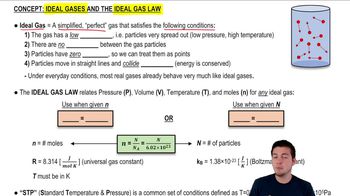
Show that the bulk modulus (Section 12–5) for an ideal gas held at constant temperature is B = P, where P is the pressure.
1
views
 Giancoli Douglas 5th editionCh. 17 - Temperature, Thermal Expansion, and the Ideal Gas LawProblem 76b
 Verified step by step guidance
 07:21
07:21
 05:21
05:21 07:31
07:31Show that the bulk modulus (Section 12–5) for an ideal gas held at constant temperature is B = P, where P is the pressure.
Estimate how many molecules of air are in each 2.0-L breath you inhale that were also in the last breath Galileo took. Assume the atmosphere is about 10 km high and of constant density. What other assumptions did you make?
A brass lid screws tightly onto a glass jar at 15°C. To help open the jar, it can be placed into a bath of hot water. After this treatment, the temperatures of the lid and the jar are both 55°C. The inside diameter of the lid is 7.0 cm. Find the size of the gap (difference in radius) that develops by this procedure.
Assume that in an alternate universe, the laws of physics are very different from ours and that “ideal” gases behave as follows: At 273.15 K and 1.00 atm pressure, 1.00 mole of an ideal gas is found to occupy 22.4 L. Obtain the form of the ideal gas law in this alternate universe, including the value of the gas constant R.
Assume that in an alternate universe, the laws of physics are very different from ours and that “ideal” gases behave as follows: At constant temperature, pressure is inversely proportional to the square of the volume.
From the known value of atmospheric pressure at the surface of the Earth, estimate the total number of air molecules in the Earth’s atmosphere.