
Textbook Question
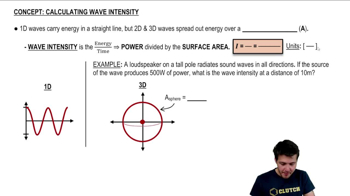
Two earthquake waves of the same frequency travel through the same portion of the Earth, but one is carrying 3.5 times the energy. What is the ratio of the amplitudes of the two waves?
1
views

 Verified step by step guidance
 02:32
02:32 02:32
02:32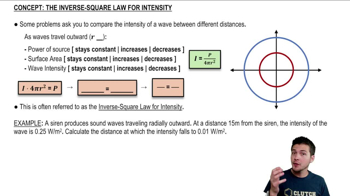 05:26
05:26Two earthquake waves of the same frequency travel through the same portion of the Earth, but one is carrying 3.5 times the energy. What is the ratio of the amplitudes of the two waves?
Consider the point x = 1.00 m on the cord of Example 15–6. Determine the maximum acceleration of this point.
A sailor strikes the side of his ship just below the surface of the sea. He hears the echo of the wave reflected from the ocean floor directly below 2.4 s later. How deep is the ocean at this point? (Use Tables 12–1 and 13–1.)
A transverse wave with a frequency of 220 Hz and a wavelength of 10.0 cm is traveling along a cord. The maximum speed of particles on the cord is 0.10 the wave speed. What is the amplitude of the wave?
A ski gondola [pronounced gon–do–la] is connected to the top of a hill by a steel cable of length 710 m and diameter 1.5 cm. As the gondola comes to the end of its run, it bumps into the terminal and sends a transverse wave pulse along the cable. It is observed that it took 17 s for the pulse to return. What is the tension in the cable?
A transverse wave pulse travels to the right along a string with a speed v = 2.0 m/s. At the shape of the pulse is given by the function D = 0.45 cos (2.6x + 1.2), where D and x are in meters. Determine a formula for the wave pulse at any time t assuming there are no frictional losses.