Ch. 15 - Wave Motion
Giancoli Douglas - Physics for Scientists and Engineers 5th edition
Giancoli Douglas5th editionPhysics for Scientists and EngineersISBN: 9780137488179Not the one you use?Change textbook
Chapter 15, Problem 28

A transverse wave with a frequency of 220 Hz and a wavelength of 10.0 cm is traveling along a cord. The maximum speed of particles on the cord is 0.10 the wave speed. What is the amplitude of the wave?

Verified step by step guidance
1
Step 1: Start by identifying the given values in the problem. The frequency \( f \) is 220 Hz, the wavelength \( \lambda \) is 10.0 cm (convert to meters: \( \lambda = 0.10 \ \text{m} \)), and the maximum particle speed \( v_{\text{particle, max}} \) is 0.10 times the wave speed \( v_{\text{wave}} \).
Step 2: Use the wave speed formula \( v_{\text{wave}} = f \cdot \lambda \) to calculate the wave speed. Substitute the given values of \( f \) and \( \lambda \) into the formula to find \( v_{\text{wave}} \).
Step 3: Recall the relationship between the maximum particle speed \( v_{\text{particle, max}} \), the wave amplitude \( A \), the angular frequency \( \omega \), and the wave speed. The formula is \( v_{\text{particle, max}} = A \cdot \omega \), where \( \omega = 2 \pi f \).
Step 4: Substitute \( \omega = 2 \pi f \) into the formula for \( v_{\text{particle, max}} \), giving \( v_{\text{particle, max}} = A \cdot 2 \pi f \). Rearrange this equation to solve for the amplitude \( A \): \( A = \frac{v_{\text{particle, max}}}{2 \pi f} \).
Step 5: Substitute the known values of \( v_{\text{particle, max}} = 0.10 \cdot v_{\text{wave}} \), \( f = 220 \ \text{Hz} \), and \( v_{\text{wave}} \) (calculated in Step 2) into the formula for \( A \). Simplify to find the amplitude of the wave.

Verified video answer for a similar problem:

This video solution was recommended by our tutors as helpful for the problem above.
Video duration:
7m
Was this helpful?

Key Concepts

Here are the essential concepts you must grasp in order to answer the question correctly.

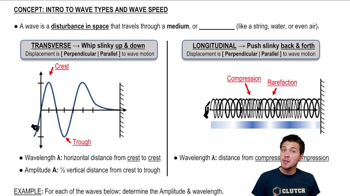
Wave Speed

Wave speed is the speed at which a wave propagates through a medium. It can be calculated using the formula v = fλ, where v is the wave speed, f is the frequency, and λ is the wavelength. In this case, with a frequency of 220 Hz and a wavelength of 10.0 cm, the wave speed can be determined, which is essential for understanding the motion of the wave.
Recommended video:
Guided course
07:19
Intro to Waves and Wave Speed

Amplitude

Amplitude is the maximum displacement of particles from their equilibrium position in a wave. It represents the height of the wave and is directly related to the energy carried by the wave. In this problem, the amplitude can be found using the relationship between the maximum speed of the particles and the wave speed, as the maximum speed is a fraction of the wave speed.
Recommended video:
Guided course
04:24
Amplitude Decay in an LRC Circuit

Transverse Waves

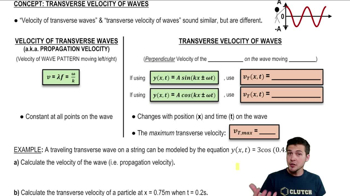
Transverse waves are waves in which the particle displacement is perpendicular to the direction of wave propagation. In the context of a cord, as the wave travels along the cord, the particles move up and down while the wave itself moves horizontally. Understanding the nature of transverse waves is crucial for analyzing the motion of particles and the characteristics of the wave.
Recommended video:
Guided course
07:32
Transverse Velocity of Waves