Ch. 15 - Wave Motion
Giancoli Douglas - Physics for Scientists and Engineers 5th edition
Giancoli Douglas5th editionPhysics for Scientists and EngineersISBN: 9780137488179Not the one you use?Change textbook
Chapter 15, Problem 9b

A ski gondola [pronounced gon–do–la] is connected to the top of a hill by a steel cable of length 710 m and diameter 1.5 cm. As the gondola comes to the end of its run, it bumps into the terminal and sends a transverse wave pulse along the cable. It is observed that it took 17 s for the pulse to return. What is the tension in the cable?

Verified step by step guidance
1
Step 1: Understand the problem. The problem involves a transverse wave traveling along a steel cable. The time it takes for the wave to travel to the end of the cable and back is given, and we need to calculate the tension in the cable. The wave speed depends on the tension and the linear mass density of the cable.
Step 2: Write the formula for the wave speed. The speed of a transverse wave on a string or cable is given by: v = Tμ, where v is the wave speed, T is the tension in the cable, and μ is the linear mass density of the cable.
Step 3: Calculate the wave speed. The wave travels a total distance of 2 × 710 m (to the end of the cable and back) in 17 s. The wave speed is therefore: v = 217 × 710.
Step 4: Determine the linear mass density. The linear mass density μ is the mass per unit length of the cable. The mass of the cable can be calculated using its volume and the density of steel. The volume of the cable is: V = π × (d2)22 × L, where d is the diameter and L is the length of the cable. Multiply the volume by the density of steel (approximately 7850 kg/m³) to find the mass, and divide by the length to find μ.
Step 5: Solve for the tension. Rearrange the wave speed formula to solve for tension: T = μ × v2. Substitute the values of μ and v to calculate the tension in the cable.

Verified video answer for a similar problem:

This video solution was recommended by our tutors as helpful for the problem above.
Video duration:
6m
Was this helpful?

Key Concepts

Here are the essential concepts you must grasp in order to answer the question correctly.

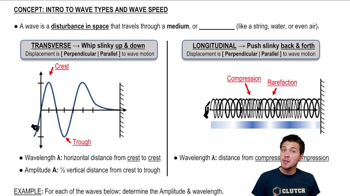
Wave Speed in a Medium

The speed of a wave in a medium is determined by the properties of that medium, such as tension and density. For a cable, the wave speed can be calculated using the formula v = √(T/μ), where T is the tension in the cable and μ is the linear mass density. Understanding this relationship is crucial for determining how quickly a wave travels through the cable.
Recommended video:
Guided course
07:19
Intro to Waves and Wave Speed

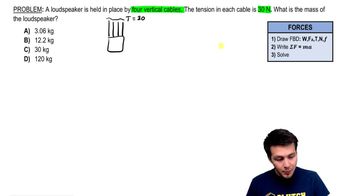
Tension in a Cable

Tension refers to the force exerted along the length of a cable or string, which is essential for maintaining its structural integrity. In the context of the ski gondola, the tension in the cable affects the speed of the wave pulse. To find the tension, one must consider the weight of the gondola and any additional forces acting on the cable.
Recommended video:
Guided course
03:25
Multiple Cables on a Loudspeaker

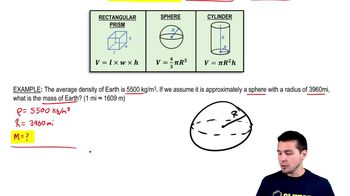
Linear Mass Density

Linear mass density (μ) is defined as the mass per unit length of a cable or string. It is calculated by dividing the mass of the cable by its length. This property is important because it influences the wave speed; a higher linear mass density results in a slower wave speed for a given tension. Understanding how to calculate and apply linear mass density is key to solving the problem.
Recommended video:
Guided course
04:33
Problems with Mass, Volume, & Density