
Ch. 11 - Angular Momentum; General Rotation
Giancoli Douglas - Physics for Scientists and Engineers 5th edition
Giancoli Douglas5th editionPhysics for Scientists and EngineersISBN: 9780137488179Not the one you use?Change textbook
Chapter 11, Problem 77c

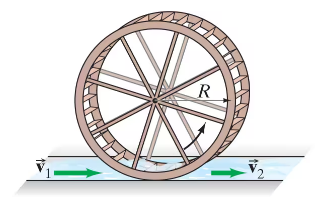
Water drives a waterwheel (or turbine) of radius R = 3.0 m as shown in Fig. 11–50. The water enters at a speed v₁ = 7.0m/s and exits from the waterwheel at a speed v₂= 3.8 m/s. If the water causes the waterwheel to make one revolution every 6.0 s, how much power is delivered to the wheel?
Waterwheel diagram showing water entering at 7.0 m/s and exiting at 3.8 m/s, with radius R = 3.0 m.

Verified step by step guidance
1
Step 1: Understand the problem. The power delivered to the waterwheel is related to the kinetic energy change of the water and the rotational motion of the wheel. Power is defined as the rate at which work is done or energy is transferred. Here, we need to calculate the power delivered to the wheel by the water.
Step 2: Calculate the mass flow rate of the water. The mass flow rate (\( \dot{m} \)) is the amount of mass passing through a given point per unit time. It can be expressed as \( \dot{m} = \rho \cdot A \cdot v \), where \( \rho \) is the density of water, \( A \) is the cross-sectional area of the water stream, and \( v \) is the velocity of the water. Assume \( \rho \) is the density of water (approximately \( 1000 \; \text{kg/m}^3 \)).
Step 3: Determine the change in kinetic energy per unit time. The kinetic energy of the water is given by \( KE = \frac{1}{2} m v^2 \). The change in kinetic energy per unit time (\( \Delta KE / t \)) is \( \dot{m} \cdot \frac{1}{2} (v_1^2 - v_2^2) \), where \( v_1 \) and \( v_2 \) are the initial and final velocities of the water, respectively.
Step 4: Relate the rotational motion of the waterwheel to its power output. The waterwheel makes one revolution every 6.0 seconds, so its angular velocity (\( \omega \)) is \( \omega = \frac{2 \pi}{T} \), where \( T \) is the period of rotation. The power delivered to the wheel is the product of the torque (\( \tau \)) and the angular velocity (\( \omega \)): \( P = \tau \cdot \omega \).
Step 5: Combine the results to find the power delivered. The torque (\( \tau \)) is related to the force exerted by the water and the radius of the wheel (\( R \)). Use the relationship \( \tau = F \cdot R \), where \( F \) is the force exerted by the water. Substitute \( \tau \) and \( \omega \) into the power equation to express the power in terms of the given quantities. Simplify the expression to calculate the power delivered to the waterwheel.

Verified video answer for a similar problem:

This video solution was recommended by our tutors as helpful for the problem above.
Video duration:
6m
Was this helpful?

Key Concepts

Here are the essential concepts you must grasp in order to answer the question correctly.

Power

Power is defined as the rate at which work is done or energy is transferred over time. In the context of a waterwheel, power can be calculated using the formula P = W/t, where W is the work done by the water on the wheel and t is the time taken. Understanding how to calculate power is essential for determining how effectively the waterwheel converts the energy from flowing water into mechanical energy.
Recommended video:

Work Done by Fluid

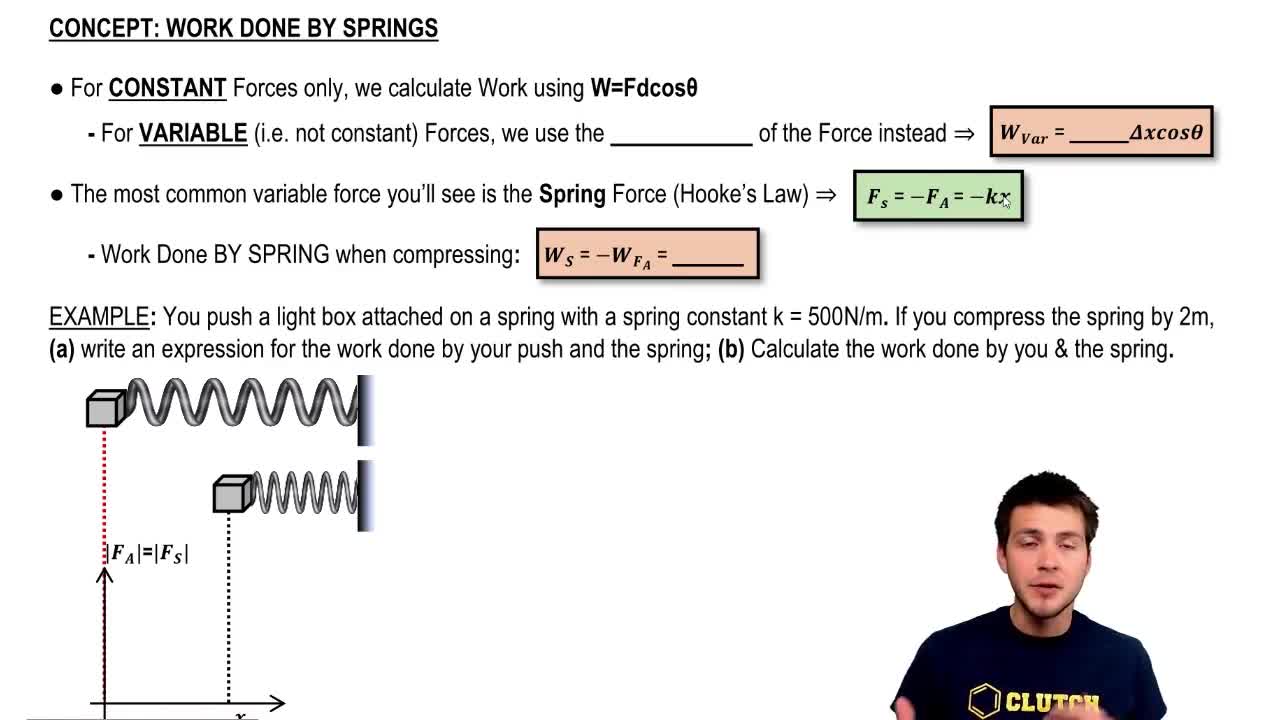
The work done by the fluid on the waterwheel can be calculated by considering the change in kinetic energy of the water as it moves through the wheel. The work done is equal to the difference in kinetic energy between the incoming and outgoing water, which can be expressed as W = 0.5 * m * (v₁² - v₂²), where m is the mass of the water. This concept is crucial for understanding how the energy from the water is transferred to the wheel.
Recommended video:
Guided course
05:58
Work Done By Springs

Angular Velocity

Angular velocity is a measure of how quickly an object rotates around an axis, typically expressed in radians per second. For the waterwheel making one revolution every 6.0 seconds, the angular velocity can be calculated as ω = 2π/T, where T is the period of rotation. This concept is important for relating the rotational motion of the wheel to the power generated by the water's flow.
Recommended video:
Guided course
06:18
Intro to Angular Momentum
Related Practice
Textbook Question

The position of a particle with mass m traveling on a helical path (see Fig. 11–48) is given by r\(\overrightarrow{r}\) = R cos (2πz/d) î + R sin (2πz/d) ĵ + zk̂ where R and d are the radius and pitch of the helix, respectively, and z has time dependence z = v𝓏t where v𝓏 is the (constant) component of velocity in the z direction. Determine the time-dependent angular momentum L\(\overrightarrow{L}\) of the particle about the origin.

1
views
Textbook Question

A particle of mass m uniformly accelerates as it moves counterclockwise along the circumference of a circle of radius R: r\(\overrightarrow{r}\) = î R cos θ + ĵ R sin θ with θ = ω₀t + (1/2)αt² , where the constants ω₀ and α are the initial angular velocity and angular acceleration, respectively. Determine the object’s tangential acceleration a\(\overrightarrow{a}\)tan and determine the torque acting on the object using τ=r×F\(\overrightarrow{\tau}\)=\(\overrightarrow{r}\]\times\) F.

1
views
Textbook Question

A boy rolls a tire along a straight level street. The tire has mass 8.0 kg, radius 0.32 m and moment of inertia about its central axis of symmetry of 0.83 kg·m². The boy pushes the tire forward away from him at a speed of 2.1 m/s and sees that the tire leans 12° to the right (Fig. 11–49). How will the resultant torque due to gravity and the normal force FN\(\overrightarrow{F_{N}\)} affect the subsequent motion of the tire? 

1
views
Textbook Question

A radio transmission tower has a mass of 76 kg and is 12 m high. The tower is anchored to the ground by a flexible joint at its base, but it is secured by three cables 120° apart (Fig. 11–52). In an analysis of a potential failure, a mechanical engineer needs to determine the behavior of the tower if one of the cables breaks. The tower would fall away from the broken cable, rotating about its base. Determine the speed of the top of the tower as a function of the rotation angle θ. Start your analysis with the rotational dynamics equation of motion dL\(\overrightarrow{L}\)/dt =τext\(\overrightarrow{\tau_{ext}\)}_{}. Approximate the tower as a tall thin rod.

1
views
Textbook Question

A baseball bat has a sweet spot where a ball can be hit with almost effortless transmission of energy. A careful analysis of baseball dynamics shows that this special spot is located at the point where an applied force would result in pure rotation of the bat about the handle grip. Determine the location of the sweet spot, xₛ, of the bat shown in Fig. 11–53. The linear mass density of the bat is given roughly by (0.61 + 3.3x²) kg/m, where x is in meters measured from the end of the handle. The entire bat is 0.84 m long. The desired rotation point should be 5.0 cm from the thin end where the bat is held. [Hint: Where is the cm of the bat?]

2
views
Textbook Question

The time-dependent position of a point object which moves counterclockwise along the circumference of a circle (radius R) in the xy plane with constant speed υ is given by r\(\overrightarrow{r}\) = î R cos ωt + ĵ R sin ωt where the constant ω = v/R. Determine the velocity v\(\overrightarrow{v}\) and angular velocity w\(\overrightarrow{w}\) of this object and then show that these three vectors obey the relationv=ω×r\(\overrightarrow{v}\)=\(\overrightarrow{\omega}\[\times\]\overrightarrow{r}\).

2
views