

A merry-go-round with a moment of inertia equal to 860 kg·m² and a radius of 3.0 m rotates with negligible friction at 1.70 rad/s. A child initially standing still next to the merry-go-round jumps onto the edge of the platform straight toward the axis of rotation causing the platform to slow to 1.25 rad/s. What is her mass?
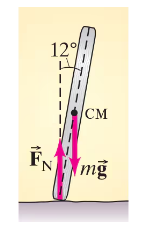
A boy rolls a tire along a straight level street. The tire has mass 8.0 kg, radius 0.32 m and moment of inertia about its central axis of symmetry of 0.83 kg·m². The boy pushes the tire forward away from him at a speed of 2.1 m/s and sees that the tire leans 12° to the right (Fig. 11–49). How will the resultant torque due to gravity and the normal force affect the subsequent motion of the tire?

Verified step by step guidance
Verified video answer for a similar problem:
Key Concepts
Torque
Moment of Inertia
Equilibrium of Forces
The position of a particle with mass m traveling on a helical path (see Fig. 11–48) is given by = R cos (2πz/d) î + R sin (2πz/d) ĵ + zk̂ where R and d are the radius and pitch of the helix, respectively, and z has time dependence z = v𝓏t where v𝓏 is the (constant) component of velocity in the z direction. Determine the time-dependent angular momentum of the particle about the origin.
A particle of mass m uniformly accelerates as it moves counterclockwise along the circumference of a circle of radius R: = î R cos θ + ĵ R sin θ with θ = ω₀t + (1/2)αt² , where the constants ω₀ and α are the initial angular velocity and angular acceleration, respectively. Determine the object’s tangential acceleration tan and determine the torque acting on the object using .
A radio transmission tower has a mass of 76 kg and is 12 m high. The tower is anchored to the ground by a flexible joint at its base, but it is secured by three cables 120° apart (Fig. 11–52). In an analysis of a potential failure, a mechanical engineer needs to determine the behavior of the tower if one of the cables breaks. The tower would fall away from the broken cable, rotating about its base. Determine the speed of the top of the tower as a function of the rotation angle θ. Start your analysis with the rotational dynamics equation of motion d/dt =. Approximate the tower as a tall thin rod.
Water drives a waterwheel (or turbine) of radius R = 3.0 m as shown in Fig. 11–50. The water enters at a speed v₁ = 7.0m/s and exits from the waterwheel at a speed v₂= 3.8 m/s. If the water causes the waterwheel to make one revolution every 6.0 s, how much power is delivered to the wheel?
The time-dependent position of a point object which moves counterclockwise along the circumference of a circle (radius R) in the xy plane with constant speed υ is given by = î R cos ωt + ĵ R sin ωt where the constant ω = v/R. Determine the velocity and angular velocity of this object and then show that these three vectors obey the relation.
