Ch. 11 - Angular Momentum; General Rotation
Giancoli Douglas - Physics for Scientists and Engineers 5th edition
Giancoli Douglas5th editionPhysics for Scientists and EngineersISBN: 9780137488179Not the one you use?Change textbook
Chapter 11, Problem 74

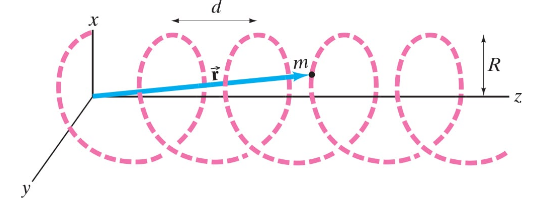
The position of a particle with mass m traveling on a helical path (see Fig. 11–48) is given by r\(\overrightarrow{r}\) = R cos (2πz/d) î + R sin (2πz/d) ĵ + zk̂ where R and d are the radius and pitch of the helix, respectively, and z has time dependence z = v𝓏t where v𝓏 is the (constant) component of velocity in the z direction. Determine the time-dependent angular momentum L\(\overrightarrow{L}\) of the particle about the origin.

Verified step by step guidance
1
Step 1: Write down the position vector of the particle in terms of time. The given position vector is r→ = R cos(2πz/d) î + R sin(2πz/d) ĵ + zk̂. Since z = v𝓏 t, substitute z into the position vector to express it as r→ = R cos(2πv𝓏t/d) î + R sin(2πv𝓏t/d) ĵ + v𝓏t k̂.
Step 2: Compute the velocity vector v→ by differentiating the position vector r→ with respect to time t. Use the chain rule for differentiation. For example, the x-component of velocity is obtained by differentiating R cos(2πv𝓏t/d) with respect to t, which gives vₓ = -R(2πv𝓏/d) sin(2πv𝓏t/d). Similarly, compute the y- and z-components of velocity.
Step 3: Write the velocity vector v→ in component form. After differentiation, the velocity vector becomes v→ = -R(2πv𝓏/d) sin(2πv𝓏t/d) î + R(2πv𝓏/d) cos(2πv𝓏t/d) ĵ + v𝓏 k̂.
Step 4: Compute the angular momentum L→ using the formula L→ = r→ × p→, where p→ = m v→ is the linear momentum. Perform the cross product of r→ and p→. Use the determinant method to compute the cross product, where the components of r→ and p→ are substituted into the determinant.
Step 5: Simplify the resulting expression for L→. After performing the cross product, simplify the terms to express the angular momentum in terms of R, d, v𝓏, m, and t. The final expression will show the time dependence of the angular momentum vector.

Verified video answer for a similar problem:

This video solution was recommended by our tutors as helpful for the problem above.
Video duration:
12m
Was this helpful?

Key Concepts

Here are the essential concepts you must grasp in order to answer the question correctly.

Angular Momentum

Angular momentum is a vector quantity that represents the rotational inertia and rotational velocity of an object. For a particle, it is defined as the cross product of the position vector and the linear momentum vector. Mathematically, it is expressed as L = r × p, where r is the position vector and p is the linear momentum (p = mv). Understanding angular momentum is crucial for analyzing rotational motion and its conservation in isolated systems.
Recommended video:
Guided course
06:18
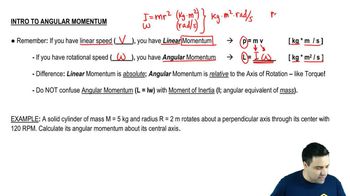
Intro to Angular Momentum

Helical Motion

Helical motion describes the movement of a particle along a helical path, which can be visualized as a spiral around a cylinder. The position of a particle in helical motion can be expressed in terms of cylindrical coordinates, incorporating both circular motion in the radial plane and linear motion along the axis. In this context, the parameters R (radius) and d (pitch) define the geometry of the helix, influencing the particle's trajectory and velocity components.
Recommended video:
Guided course
11:33
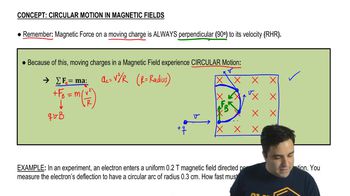
Circular Motion of Charges in Magnetic Fields

Time Dependence in Motion

Time dependence in motion refers to how the position and velocity of a particle change over time. In the given problem, the vertical position z is expressed as a function of time, z = v𝓏 t, indicating that the particle moves with a constant velocity in the z direction. This time dependence is essential for determining the particle's angular momentum, as it affects the position vector and, consequently, the calculation of angular momentum over time.
Recommended video:
Guided course
07:41
Intro to Position-Time Graphs & Velocity
Related Practice
Textbook Question

A merry-go-round with a moment of inertia equal to 860 kg·m² and a radius of 3.0 m rotates with negligible friction at 1.70 rad/s. A child initially standing still next to the merry-go-round jumps onto the edge of the platform straight toward the axis of rotation causing the platform to slow to 1.25 rad/s. What is her mass?

Textbook Question

A particle of mass m uniformly accelerates as it moves counterclockwise along the circumference of a circle of radius R: r\(\overrightarrow{r}\) = î R cos θ + ĵ R sin θ with θ = ω₀t + (1/2)αt² , where the constants ω₀ and α are the initial angular velocity and angular acceleration, respectively. Determine the object’s tangential acceleration a\(\overrightarrow{a}\)tan and determine the torque acting on the object using τ=r×F\(\overrightarrow{\tau}\)=\(\overrightarrow{r}\]\times\) F.

1
views
Textbook Question

A boy rolls a tire along a straight level street. The tire has mass 8.0 kg, radius 0.32 m and moment of inertia about its central axis of symmetry of 0.83 kg·m². The boy pushes the tire forward away from him at a speed of 2.1 m/s and sees that the tire leans 12° to the right (Fig. 11–49). How will the resultant torque due to gravity and the normal force FN\(\overrightarrow{F_{N}\)} affect the subsequent motion of the tire? 

1
views
Textbook Question

Water drives a waterwheel (or turbine) of radius R = 3.0 m as shown in Fig. 11–50. The water enters at a speed v₁ = 7.0m/s and exits from the waterwheel at a speed v₂= 3.8 m/s. If the water causes the waterwheel to make one revolution every 6.0 s, how much power is delivered to the wheel?

2
views
Textbook Question

The time-dependent position of a point object which moves counterclockwise along the circumference of a circle (radius R) in the xy plane with constant speed υ is given by r\(\overrightarrow{r}\) = î R cos ωt + ĵ R sin ωt where the constant ω = v/R. Determine the velocity v\(\overrightarrow{v}\) and angular velocity w\(\overrightarrow{w}\) of this object and then show that these three vectors obey the relationv=ω×r\(\overrightarrow{v}\)=\(\overrightarrow{\omega}\[\times\]\overrightarrow{r}\).

2
views
Textbook Question

Suppose the solid wheel of Fig. 11–42 has a mass of 260 g and rotates at 85 rad/s; it has radius 6.0 cm and is mounted at the center of a horizontal thin axle 25 cm long. At what rate does the axle precess?

1
views