

An engineer estimates that under the most adverse expected weather conditions, the total force on the highway sign in Fig. 11–33 will be = (± 2.4 î - 4.1 ĵ) kN, acting at the cm. What torque does this force exert about the base O?
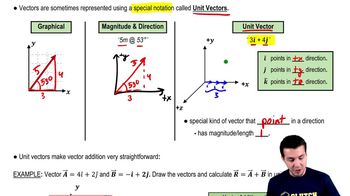
Show that î x ĵ = k̂ , î x k̂ = - ĵ, and ĵ x k̂ = î.
Verified step by step guidance
Verified video answer for a similar problem:
Key Concepts
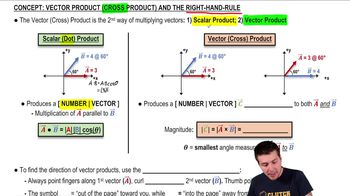
Vector Cross Product
Unit Vectors
Right-Hand Rule
A woman of mass m stands at the edge of a solid cylindrical platform of mass M and radius R. At t = 0, the platform is rotating with negligible friction at angular velocity ω0 about a vertical axis through its center, and the woman begins walking with speed υ (relative to the platform) toward the center of the platform. Determine the angular velocity of the system as a function of time.
Calculate the angular momentum of a particle of mass m moving with constant velocity υ for two cases (see Fig. 11–34): about O′.
A woman of mass m stands at the edge of a solid cylindrical platform of mass M and radius R. At t = 0, the platform is rotating with negligible friction at angular velocity ω0 about a vertical axis through its center, and the woman begins walking with speed υ (relative to the platform) toward the center of the platform. What will be the angular velocity when the woman reaches the center?
A person of mass 75 kg stands at the center of a rotating merry-go-round platform of radius 3.0 m and moment of inertia 920. kg·m². The platform rotates without friction with angular velocity 0.95 rad/s. The person walks radially to the edge of the platform. Calculate the rotational kinetic energy of the system of platform plus person before and after the person’s walk.
Calculate the angular momentum of a particle of mass m moving with constant velocity υ for two cases (see Fig. 11–34): about origin O.
