Ch. 11 - Angular Momentum; General Rotation
Giancoli Douglas - Physics for Scientists and Engineers 5th edition
Giancoli Douglas5th editionPhysics for Scientists and EngineersISBN: 9780137488179Not the one you use?Change textbook
Chapter 11, Problem 36b

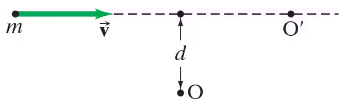
Calculate the angular momentum of a particle of mass m moving with constant velocity υ for two cases (see Fig. 11–34): about O′.

Verified step by step guidance
1
Identify the formula for angular momentum. Angular momentum (L) is given by the cross product of the position vector (r) and the linear momentum (p): L=r×p. Since linear momentum is the product of mass (m) and velocity (υ), we can write: L=r×mυ.
Determine the position vector (r) of the particle relative to the point O′. The position vector is the vector from O′ to the particle's location. Analyze the geometry of the problem to express r in terms of its components or magnitude and direction.
Express the velocity vector (υ) of the particle. Since the particle is moving with constant velocity, its velocity vector will have a fixed magnitude and direction. Ensure that the direction of υ is consistent with the problem's description.
Compute the cross product r×mυ. Use the right-hand rule to determine the direction of the angular momentum vector. If r and υ are given in component form, use the determinant method to calculate the cross product.
Simplify the expression for angular momentum. If the magnitudes of r and υ are given, and the angle θ between them is known, you can use the scalar form of the cross product: L=mrυsinθ. Ensure that the final expression is in terms of the given variables (m, υ, r, and θ).

Verified video answer for a similar problem:

This video solution was recommended by our tutors as helpful for the problem above.
Video duration:
3m
Was this helpful?

Key Concepts

Here are the essential concepts you must grasp in order to answer the question correctly.

Angular Momentum

Angular momentum is a vector quantity that represents the rotational motion of an object. It is defined as the product of the object's moment of inertia and its angular velocity. For a particle, angular momentum (L) can be calculated using the formula L = r × p, where r is the position vector from the pivot point to the particle, and p is the linear momentum of the particle (p = mv).
Recommended video:
Guided course
06:18
Intro to Angular Momentum

Position Vector

The position vector is a vector that represents the position of a point in space relative to a reference point, often the origin of a coordinate system. In the context of angular momentum, the position vector (r) is crucial as it determines the distance and direction from the pivot point to the particle. This vector is essential for calculating the angular momentum about different points.
Recommended video:
Guided course
07:07
Final Position Vector

Conservation of Angular Momentum

The conservation of angular momentum states that if no external torque acts on a system, the total angular momentum of that system remains constant. This principle is fundamental in analyzing the motion of particles and systems in rotational dynamics, allowing us to predict how the angular momentum will behave under various conditions, such as when calculating it about different points.
Recommended video:
Guided course
12:12
Conservation of Angular Momentum
Related Practice
Textbook Question

Two identical particles have equal but opposite momenta, p\(\overrightarrow{p}\) and p-\(\overrightarrow{p}\), but they are not traveling along the same line. Show that the total angular momentum of this system does not depend on the choice of origin.

Textbook Question

An engineer estimates that under the most adverse expected weather conditions, the total force on the highway sign in Fig. 11–33 will be F\(\overrightarrow{F}\) = (± 2.4 î - 4.1 ĵ) kN, acting at the cm. What torque does this force exert about the base O?

2
views
Textbook Question

A particle is at the position (x, y, z) = (1.0, 2.0, 3.0)m. It is traveling with a vector velocity (-5.0 ,+ 2.8, -3.1)m/s. Its mass is 4.3 kg. What is its vector angular momentum about the origin?

2
views
Textbook Question

Calculate the angular momentum of a particle of mass m moving with constant velocity υ for two cases (see Fig. 11–34): about origin O.

1
views
Textbook Question

Show that  î x ĵ = k̂ , î x k̂ = - ĵ, and ĵ x k̂ = î.

2
views
Textbook Question

Two lightweight rods 24 cm in length are mounted perpendicular to an axle and at 180° to each other (Fig. 11–35). At the end of each rod is a 480-g mass. The rods are spaced 42 cm apart along the axle. The axle rotates at 4.5 rad/s.

(a) What is the component of the total angular momentum along the axle?

(b) What angle does the vector angular momentum make with the axle? [Hint: Remember that the vector angular momentum must be calculated about the same point for both masses, which could be the cm.]

1
views