
Ch. 11 - Angular Momentum; General Rotation
Giancoli Douglas - Physics for Scientists and Engineers 5th edition
Giancoli Douglas5th editionPhysics for Scientists and EngineersISBN: 9780137488179Not the one you use?Change textbook
Chapter 11, Problem 14b

A woman of mass m stands at the edge of a solid cylindrical platform of mass M and radius R. At t = 0, the platform is rotating with negligible friction at angular velocity ω0 about a vertical axis through its center, and the woman begins walking with speed υ (relative to the platform) toward the center of the platform. What will be the angular velocity when the woman reaches the center?

Verified step by step guidance
1
Start by identifying the principle of conservation of angular momentum. Since there is negligible friction, the total angular momentum of the system (woman + platform) is conserved.
Write the initial angular momentum of the system. The platform's moment of inertia is given by \( I_{platform} = \frac{1}{2} M R^2 \), and the woman's contribution to angular momentum is \( m R^2 \omega_0 \) (since she is initially at the edge). The total initial angular momentum is \( L_{initial} = \left( \frac{1}{2} M R^2 + m R^2 \right) \omega_0 \).
As the woman walks toward the center, her distance from the axis of rotation decreases, which changes her moment of inertia. At any point, her moment of inertia is \( I_{woman} = m r^2 \), where \( r \) is her distance from the center. The platform's moment of inertia remains constant.
Write the final angular momentum of the system when the woman reaches the center. At this point, her moment of inertia becomes zero (since \( r = 0 \)), and the platform's moment of inertia remains \( \frac{1}{2} M R^2 \). The final angular momentum is \( L_{final} = I_{platform} \omega_{final} = \frac{1}{2} M R^2 \omega_{final} \).
Set the initial angular momentum equal to the final angular momentum to solve for the final angular velocity \( \omega_{final} \). Use the equation \( \left( \frac{1}{2} M R^2 + m R^2 \right) \omega_0 = \frac{1}{2} M R^2 \omega_{final} \). Simplify and solve for \( \omega_{final} \).

Verified video answer for a similar problem:

This video solution was recommended by our tutors as helpful for the problem above.
Video duration:
9m
Was this helpful?

Key Concepts

Here are the essential concepts you must grasp in order to answer the question correctly.

Conservation of Angular Momentum

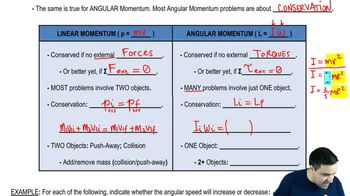
The principle of conservation of angular momentum states that if no external torque acts on a system, the total angular momentum of that system remains constant. In this scenario, the initial angular momentum of the platform and the woman combined must equal the final angular momentum when the woman reaches the center, allowing us to relate the initial and final angular velocities.
Recommended video:
Guided course
12:12
Conservation of Angular Momentum

Moment of Inertia

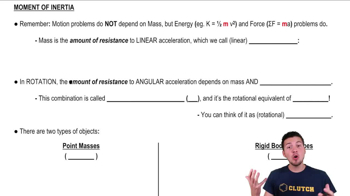
The moment of inertia is a measure of an object's resistance to changes in its rotation, depending on the mass distribution relative to the axis of rotation. For a system involving a rotating platform and a moving person, the moment of inertia will change as the woman moves toward the center, affecting the overall angular velocity of the system.
Recommended video:
Guided course
11:47
Intro to Moment of Inertia

Relative Velocity

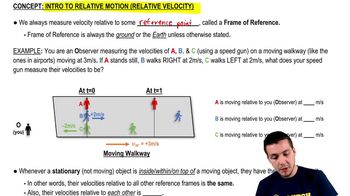
Relative velocity refers to the velocity of one object as observed from another object. In this problem, the woman's speed is given relative to the platform, which means we must account for both her movement and the platform's rotation to determine the final angular velocity when she reaches the center.
Recommended video:
Guided course
04:27
Intro to Relative Motion (Relative Velocity)
Related Practice
Textbook Question

An engineer estimates that under the most adverse expected weather conditions, the total force on the highway sign in Fig. 11–33 will be F\(\overrightarrow{F}\) = (± 2.4 î - 4.1 ĵ) kN, acting at the cm. What torque does this force exert about the base O?

2
views
Textbook Question

A woman of mass m stands at the edge of a solid cylindrical platform of mass M and radius R. At t = 0, the platform is rotating with negligible friction at angular velocity ω0 about a vertical axis through its center, and the woman begins walking with speed υ (relative to the platform) toward the center of the platform. Determine the angular velocity of the system as a function of time.

1
views
Textbook Question

A uniform disk turns at 4.1 rev/s around a frictionless central axis. A nonrotating rod, of the same mass as the disk and length equal to the disk’s diameter, is dropped onto the freely spinning disk, Fig. 11–32. They then turn together around the spindle with their centers superposed. What is the angular frequency in rev/s of the combination?

2
views
Textbook Question

A person of mass 75 kg stands at the center of a rotating merry-go-round platform of radius 3.0 m and moment of inertia 920. kg·m². The platform rotates without friction with angular velocity 0.95 rad/s. The person walks radially to the edge of the platform. Calculate the rotational kinetic energy of the system of platform plus person before and after the person’s walk.

2
views
Textbook Question

Calculate the angular momentum of a particle of mass m moving with constant velocity υ for two cases (see Fig. 11–34): about origin O.

1
views
Textbook Question

Show that  î x ĵ = k̂ , î x k̂ = - ĵ, and ĵ x k̂ = î.

2
views