
Ch. 04 - Dynamics: Newton's Laws of Motion
Giancoli Douglas - Physics for Scientists and Engineers 5th edition
Giancoli Douglas5th editionPhysics for Scientists and EngineersISBN: 9780137488179Not the one you use?Change textbook
Chapter 4, Problem 63b

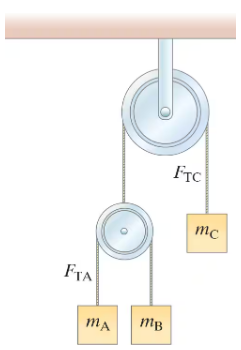
The double Atwood machine shown in Fig. 4–55 has frictionless, massless pulleys and cords. Determine the tensions FTA and FTC in the cords.

Verified step by step guidance
1
Step 1: Analyze the system and identify forces acting on each mass. For mass mA and mB, the tension FTA acts upward, while their weights (mA * g and mB * g) act downward. For mass mC, the tension FTC acts upward, and its weight (mC * g) acts downward.
Step 2: Write the equations of motion for each mass. For mA and mB, the net force is determined by the difference between the tension FTA and their combined weights. For mC, the net force is determined by the difference between FTC and its weight.
Step 3: Relate the tensions FTA and FTC using the pulley system. Since the pulleys are frictionless and massless, the tension in the cord connected to mA and mB (FTA) is related to the tension in the cord connected to mC (FTC). Specifically, FTC = 2 * FTA because the lower pulley redistributes the tension.
Step 4: Apply Newton's second law (F = ma) to each mass. For mA and mB, the acceleration is shared due to the cord connection, and their combined equation is: FTA = (mA + mB) * g - (mA + mB) * a. For mC, the equation is: FTC = mC * g - mC * a.
Step 5: Solve the system of equations. Substitute FTC = 2 * FTA into the equation for mC, and use the equations for mA and mB to find the tensions FTA and FTC in terms of the masses and acceleration. This will provide the expressions for the tensions in the cords.

Key Concepts

Here are the essential concepts you must grasp in order to answer the question correctly.

Tension in Cords

Tension is the force transmitted through a string, rope, or cord when it is pulled tight by forces acting from opposite ends. In the context of the double Atwood machine, the tensions F_TA and F_TC are crucial for analyzing the forces acting on the masses m_A, m_B, and m_C. Understanding how tension varies in different segments of the system is essential for solving for these forces.
Recommended video:
Guided course
06:34
Calculating Tension in a Pendulum with Energy Conservation

Newton's Second Law

Newton's Second Law states that the acceleration of an object is directly proportional to the net force acting on it and inversely proportional to its mass (F = ma). This principle is fundamental in analyzing the motion of the masses in the Atwood machine. By applying this law to each mass, one can derive equations that relate the tensions and the weights of the masses.
Recommended video:
Guided course
06:54
Intro to Forces & Newton's Second Law

Equilibrium Conditions

In a system like the double Atwood machine, equilibrium conditions imply that the sum of forces acting on each mass must equal zero when the system is at rest or moving with constant velocity. This concept allows us to set up equations based on the forces acting on m_A, m_B, and m_C, leading to a system of equations that can be solved for the unknown tensions F_TA and F_TC.
Recommended video:
Guided course
10:13
Torque & Equilibrium
Related Practice
Textbook Question

Consider the system shown in Fig. 4–68 with mA = 8.2kg and mB = 11.5kg. The angles θA = 59° and θB = 32°. In the absence of friction, what force F\(\overrightarrow{F}\) would be required to pull the masses at a constant velocity up the fixed inclines?

2
views
Textbook Question

Consider the system shown in Fig. 4–68 with mA = 8.2kg and mB = 11.5kg. The angles θA = 59° and θB = 32°. In the absence of F\(\overrightarrow{F}\), what is the tension in the string?

1
views
Textbook Question

Determine a formula for the acceleration of the system shown in Fig. 4–49 (see Problem 55) if the cord has a non-negligible mass mC. Specify in terms of ℓA and ℓB , the lengths of cord from the respective masses to the pulley. (The total cord length is ℓA + ℓB.)

1
views
Textbook Question

The double Atwood machine shown in Fig. 4–55 has frictionless, massless pulleys and cords. Determine the acceleration of masses mA, mB, and mC.

2
views
Textbook Question

Three mountain climbers who are roped together in a line are ascending an icefield inclined at 29° to the horizontal (Fig. 4–67). The last climber slips, pulling the second climber off his feet. The first climber is able to hold them both. If each climber has a mass of 75 kg, calculate the tension in each of the two sections of rope between the three climbers. Ignore friction between the ice and the fallen climbers.

<IMAGE>

1
views
Textbook Question

As shown in Fig. 4–48, five balls (masses 2.00, 2.05, 2.10, 2.15, 2.20 kg) hang from a crossbar. Each mass is supported by '5-lb test' fishing line which will break when its tension force exceeds 22.2 N (5.00lb). When this device is placed in an elevator, which accelerates upward, only the lines attached to the 2.05 and 2.00 kg masses do not break. Within what range is the elevator's acceleration?

1
views