Ch. 04 - Dynamics: Newton's Laws of Motion
Giancoli Douglas - Physics for Scientists and Engineers 5th edition
Giancoli Douglas5th editionPhysics for Scientists and EngineersISBN: 9780137488179Not the one you use?Change textbook
Chapter 4, Problem 50

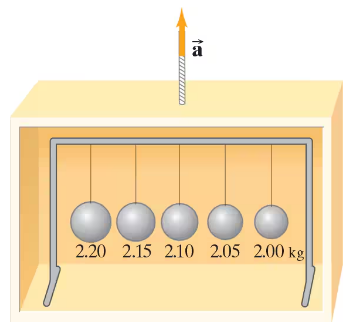
As shown in Fig. 4–48, five balls (masses 2.00, 2.05, 2.10, 2.15, 2.20 kg) hang from a crossbar. Each mass is supported by '5-lb test' fishing line which will break when its tension force exceeds 22.2 N (5.00lb). When this device is placed in an elevator, which accelerates upward, only the lines attached to the 2.05 and 2.00 kg masses do not break. Within what range is the elevator's acceleration?
Five hanging balls with varying masses are supported by fishing lines, illustrating tension forces in an accelerating elevator.

Verified step by step guidance
1
Step 1: Begin by analyzing the forces acting on each mass. The tension in the fishing line must support both the gravitational force (weight) of the mass and the additional force due to the elevator's upward acceleration. The total force on the fishing line can be expressed as: T = m(g + a), where T is the tension, m is the mass, g is the acceleration due to gravity (9.8 m/s²), and a is the elevator's upward acceleration.
Step 2: Identify the critical condition for the fishing line to break. The fishing line will break if the tension exceeds 22.2 N. Therefore, for each mass, the condition for breaking is: m(g + a) > 22.2 N. Conversely, for the fishing line not to break, the condition is: m(g + a) ≤ 22.2 N.
Step 3: Apply the non-breaking condition to the 2.05 kg mass. Using the formula T = m(g + a), substitute m = 2.05 kg and T = 22.2 N to find the maximum acceleration a_max for which the line does not break. Solve the inequality: 2.05(9.8 + a) ≤ 22.2.
Step 4: Apply the breaking condition to the 2.10 kg mass. Using the same formula, substitute m = 2.10 kg and T = 22.2 N to find the minimum acceleration a_min for which the line breaks. Solve the inequality: 2.10(9.8 + a) > 22.2.
Step 5: Combine the results from Steps 3 and 4 to determine the range of the elevator's acceleration. The acceleration must be such that the fishing lines for the 2.05 kg and 2.00 kg masses do not break, but the line for the 2.10 kg mass does break. This gives the range of acceleration as a_min < a < a_max.

Verified video answer for a similar problem:

This video solution was recommended by our tutors as helpful for the problem above.
Video duration:
7m
Was this helpful?

Key Concepts

Here are the essential concepts you must grasp in order to answer the question correctly.

Tension in a Rope

Tension is the force exerted along a rope or string when it is pulled tight by forces acting from opposite ends. In this scenario, the tension in the fishing line must counteract both the weight of the hanging masses and any additional force due to the elevator's acceleration. Understanding how tension varies with acceleration is crucial for determining which lines will break.
Recommended video:
Guided course
06:34
Calculating Tension in a Pendulum with Energy Conservation

Newton's Second Law of Motion

Newton's Second Law states that the force acting on an object is equal to the mass of that object multiplied by its acceleration (F = ma). This principle is essential for analyzing the forces acting on the masses in the elevator. By applying this law, we can calculate the net force and determine the conditions under which the fishing lines will break.
Recommended video:
Guided course
06:54
Intro to Forces & Newton's Second Law

Weight and Gravitational Force

Weight is the force exerted by gravity on an object, calculated as the product of its mass and the acceleration due to gravity (W = mg). In this problem, the weight of each mass contributes to the tension in the fishing line. Understanding how weight interacts with the forces in the elevator helps in assessing the limits of the fishing line's strength.
Recommended video:
Guided course
07:32
Weight Force & Gravitational Acceleration