Ch. 04 - Dynamics: Newton's Laws of Motion
Giancoli Douglas - Physics for Scientists and Engineers 5th edition
Giancoli Douglas5th editionPhysics for Scientists and EngineersISBN: 9780137488179Not the one you use?Change textbook
Chapter 4, Problem 88a

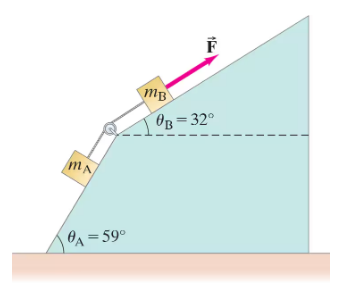
Consider the system shown in Fig. 4–68 with mA = 8.2kg and mB = 11.5kg. The angles θA = 59° and θB = 32°. In the absence of friction, what force F\(\overrightarrow{F}\) would be required to pull the masses at a constant velocity up the fixed inclines?
Diagram of two masses on inclined planes with angles 59° and 32°, showing the force required to move them at constant velocity.

Verified step by step guidance
1
Identify the forces acting on each mass. For m_A and m_B, the forces include the gravitational force (m_A * g and m_B * g), the normal force from the incline, and the component of the pulling force F→ along the incline.
Break the gravitational force into components parallel and perpendicular to the incline for each mass. For m_A, the parallel component is m_A * g * sin(θ_A), and for m_B, it is m_B * g * sin(θ_B).
Since the system is moving at a constant velocity, the net force along the incline for each mass must be zero. This means the pulling force F→ must balance the sum of the parallel components of the gravitational forces for both masses.
Write the equation for the total force required: F→ = m_A * g * sin(θ_A) + m_B * g * sin(θ_B).
Substitute the given values (m_A = 8.2 kg, m_B = 11.5 kg, θ_A = 59°, θ_B = 32°, and g = 9.8 m/s²) into the equation to calculate the required force F→.

Verified video answer for a similar problem:

This video solution was recommended by our tutors as helpful for the problem above.
Video duration:
10m
Was this helpful?

Key Concepts

Here are the essential concepts you must grasp in order to answer the question correctly.

Inclined Plane

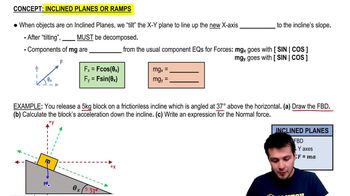
An inclined plane is a flat surface tilted at an angle to the horizontal. It allows for the analysis of forces acting on objects moving along the slope. The gravitational force acting on an object on an incline can be resolved into two components: one parallel to the incline, which causes motion, and one perpendicular to the incline, which affects the normal force.
Recommended video:
Guided course
06:59
Intro to Inclined Planes

Newton's Second Law

Newton's Second Law states that the acceleration of an object is directly proportional to the net force acting on it and inversely proportional to its mass. This principle is crucial for determining the force required to move the masses at a constant velocity, as it implies that the net force must equal zero when the velocity is constant, leading to the equation F_net = m * a, where a = 0.
Recommended video:
Guided course
06:54
Intro to Forces & Newton's Second Law

Force of Gravity

The force of gravity acting on an object is given by the equation F_gravity = m * g, where m is the mass and g is the acceleration due to gravity (approximately 9.81 m/s²). On an incline, this force can be decomposed into components that influence the motion along the slope, which is essential for calculating the force needed to maintain constant velocity against gravitational pull.
Recommended video:
Guided course
05:20
Acceleration Due to Gravity