Ch. 04 - Dynamics: Newton's Laws of Motion
Giancoli Douglas - Physics for Scientists and Engineers 5th edition
Giancoli Douglas5th editionPhysics for Scientists and EngineersISBN: 9780137488179Not the one you use?Change textbook
Chapter 4, Problem 40b

At the instant a race began, a 65-kg sprinter exerted a force of 720 N on the starting block at a 22° angle with respect to the ground. If the force was exerted for 0.32 s, with what speed did the sprinter leave the starting block?

Verified step by step guidance
1
Step 1: Break the force into its horizontal and vertical components. The horizontal component of the force is given by \( F_x = F \cdot \cos(\theta) \), and the vertical component is \( F_y = F \cdot \sin(\theta) \), where \( F = 720 \; \text{N} \) and \( \theta = 22^\circ \).
Step 2: Focus on the horizontal motion, as it determines the sprinter's speed. Use Newton's second law \( F_x = m \cdot a \) to find the horizontal acceleration \( a \). Rearrange the equation to solve for \( a \): \( a = \frac{F_x}{m} \), where \( m = 65 \; \text{kg} \).
Step 3: Use the kinematic equation \( v = u + a \cdot t \) to calculate the final velocity \( v \). Here, \( u = 0 \; \text{m/s} \) (initial velocity), \( a \) is the horizontal acceleration from Step 2, and \( t = 0.32 \; \text{s} \) is the time the force was applied.
Step 4: Substitute the values of \( a \) and \( t \) into the kinematic equation to find \( v \). This will give the sprinter's speed as they leave the starting block.
Step 5: Verify the solution by ensuring all units are consistent (e.g., force in Newtons, mass in kilograms, time in seconds) and that the calculations align with the physical principles of motion.

Verified video answer for a similar problem:

This video solution was recommended by our tutors as helpful for the problem above.
Video duration:
6m
Was this helpful?

Key Concepts

Here are the essential concepts you must grasp in order to answer the question correctly.

Newton's Second Law of Motion

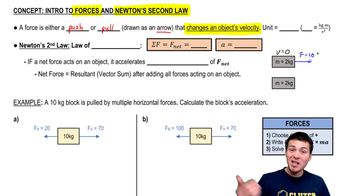
Newton's Second Law states that the acceleration of an object is directly proportional to the net force acting on it and inversely proportional to its mass. This relationship is expressed by the formula F = ma, where F is the net force, m is the mass, and a is the acceleration. In this scenario, understanding how the sprinter's force translates into acceleration is crucial for determining the speed at which they leave the starting block.
Recommended video:
Guided course
06:54
Intro to Forces & Newton's Second Law

Components of Force

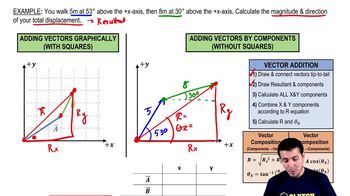
When a force is applied at an angle, it can be broken down into horizontal and vertical components using trigonometric functions. The horizontal component is found using cosine, while the vertical component uses sine. For the sprinter, only the horizontal component of the force contributes to the acceleration in the direction of motion, which is essential for calculating the resulting speed.
Recommended video:
Guided course
07:30
Vector Addition By Components

Kinematic Equations

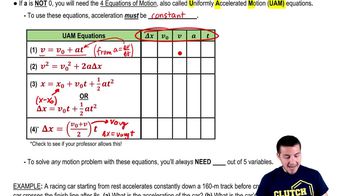
Kinematic equations describe the motion of objects under constant acceleration. They relate displacement, initial velocity, final velocity, acceleration, and time. In this case, the equation v = u + at can be used, where v is the final velocity, u is the initial velocity (zero for a sprinter starting from rest), a is the acceleration derived from the force, and t is the time the force is applied.
Recommended video:
Guided course
08:25
Kinematics Equations