Ch. 04 - Dynamics: Newton's Laws of Motion
Giancoli Douglas - Physics for Scientists and Engineers 5th edition
Giancoli Douglas5th editionPhysics for Scientists and EngineersISBN: 9780137488179Not the one you use?Change textbook
Chapter 4, Problem 16

A 75-kg petty thief wants to escape from a third-story jail window. Unfortunately, a makeshift rope made of sheets tied together can support a mass of only 62 kg. How might the thief use this 'rope' to escape? Give a quantitative answer.

Verified step by step guidance
1
Determine the maximum force the makeshift rope can support. The maximum tension in the rope is equal to the weight of a 62-kg mass. Use the formula for weight: T=mg, where m is the mass (62 kg) and g is the acceleration due to gravity (9.8 m/s²).
Calculate the thief's weight using the same formula: W=mg, where m is the thief's mass (75 kg). This gives the force the rope would need to support if the thief were stationary.
Recognize that the rope cannot support the thief's full weight. To reduce the tension in the rope, the thief must accelerate downward slightly, effectively reducing the net force the rope needs to support. Use Newton's second law: T=m(g-a), where a is the downward acceleration.
Set the maximum tension the rope can support (T) equal to the weight of the 62-kg mass: 62g=75(g-a). Solve for the downward acceleration a.
Once the downward acceleration a is calculated, the thief can descend safely by ensuring they slide down the rope with this acceleration, reducing the tension in the rope to a value it can support.

Verified video answer for a similar problem:

This video solution was recommended by our tutors as helpful for the problem above.
Was this helpful?

Key Concepts

Here are the essential concepts you must grasp in order to answer the question correctly.

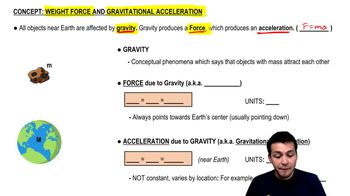
Weight and Gravitational Force

Weight is the force exerted by gravity on an object, calculated as the product of mass and the acceleration due to gravity (approximately 9.81 m/s² on Earth). In this scenario, the thief's weight is 75 kg × 9.81 m/s², which equals about 735.75 N. Understanding weight is crucial to determine if the makeshift rope can support the thief's mass.
Recommended video:
Guided course
07:32
Weight Force & Gravitational Acceleration

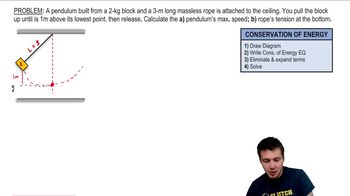
Tension in a Rope

Tension is the force transmitted through a rope or string when it is pulled tight by forces acting from opposite ends. The maximum tension the rope can withstand is equivalent to the weight it can support, which is 62 kg × 9.81 m/s², or about 609.42 N. This concept is essential to assess whether the rope can safely hold the thief's weight during the escape.
Recommended video:
Guided course
06:34
Calculating Tension in a Pendulum with Energy Conservation

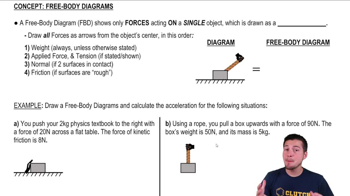
Free Body Diagram

A free body diagram is a visual representation used to show all the forces acting on an object. In this case, drawing a free body diagram for the thief can help analyze the forces at play, including gravitational force and tension in the rope. This analysis is vital for determining how the thief might escape without exceeding the rope's weight limit.
Recommended video:
Guided course
08:42
Free-Body Diagrams