Ch. 04 - Dynamics: Newton's Laws of Motion
Giancoli Douglas - Physics for Scientists and Engineers 5th edition
Giancoli Douglas5th editionPhysics for Scientists and EngineersISBN: 9780137488179Not the one you use?Change textbook
Chapter 4, Problem 40a

At the instant a race began, a 65-kg sprinter exerted a force of 720 N on the starting block at a 22° angle with respect to the ground. What was the horizontal acceleration of the sprinter?

Verified step by step guidance
1
Identify the forces acting on the sprinter. The sprinter exerts a force of 720 N at an angle of 22° with respect to the ground. This force can be broken into two components: a horizontal component and a vertical component.
Calculate the horizontal component of the force using the formula: Fh = Fcos(θ), where F is the total force (720 N) and θ is the angle (22°).
Determine the net horizontal force acting on the sprinter. Since the problem does not mention any opposing forces (like friction), assume the horizontal component of the applied force is the net force.
Use Newton's second law of motion to calculate the horizontal acceleration. The formula is: a = Fh / m, where Fh is the horizontal force and m is the mass of the sprinter (65 kg).
Substitute the values into the equations and simplify to find the horizontal acceleration. Ensure the units are consistent (N for force, kg for mass, and m/s² for acceleration).

Verified video answer for a similar problem:

This video solution was recommended by our tutors as helpful for the problem above.
Was this helpful?

Key Concepts

Here are the essential concepts you must grasp in order to answer the question correctly.

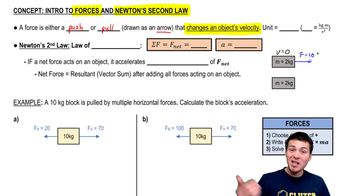
Newton's Second Law of Motion

Newton's Second Law states that the acceleration of an object is directly proportional to the net force acting on it and inversely proportional to its mass. This relationship is expressed by the formula F = ma, where F is the net force, m is the mass, and a is the acceleration. Understanding this law is crucial for calculating the horizontal acceleration of the sprinter based on the force exerted.
Recommended video:
Guided course
06:54
Intro to Forces & Newton's Second Law

Components of Force

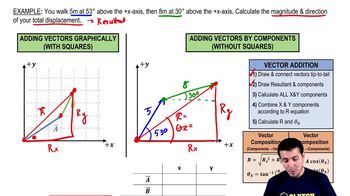
When a force is applied at an angle, it can be resolved into horizontal and vertical components using trigonometric functions. The horizontal component can be found using the cosine of the angle, while the vertical component uses the sine. In this case, the horizontal force component will be essential for determining the sprinter's horizontal acceleration.
Recommended video:
Guided course
07:30
Vector Addition By Components

Kinematics

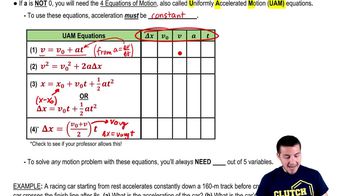
Kinematics is the branch of mechanics that deals with the motion of objects without considering the forces that cause the motion. It provides the framework for analyzing how objects move, including concepts like acceleration, velocity, and displacement. In this scenario, kinematic principles will help relate the calculated horizontal force to the resulting acceleration of the sprinter.
Recommended video:
Guided course
08:25
Kinematics Equations