
Ch. 10 - Rotational Motion
Giancoli Douglas - Physics for Scientists and Engineers 5th edition
Giancoli Douglas5th editionPhysics for Scientists and EngineersISBN: 9780137488179Not the one you use?Change textbook
Chapter 10, Problem 71a

II) A uniform solid sphere of radius r0 = 24.5 cm and mass m = 1.60 kg starts from rest and rolls without slipping down a 30.0° incline that is 10.0 m long. Calculate its translational and rotational speeds when it reaches the bottom. Avoid putting in numbers until the end so you can answer.

Verified step by step guidance
1
Start by identifying the forces acting on the sphere. The sphere rolls without slipping, so both translational and rotational motion are involved. The gravitational force causes the sphere to accelerate down the incline, and the frictional force ensures rolling without slipping.
Apply the principle of conservation of energy. The total mechanical energy at the top of the incline (potential energy) is converted into both translational kinetic energy and rotational kinetic energy at the bottom. Write the energy conservation equation: \( m g h = \frac{1}{2} m v^2 + \frac{1}{2} I \omega^2 \), where \( h \) is the height of the incline, \( v \) is the translational speed, \( I \) is the moment of inertia of the sphere, and \( \omega \) is the angular speed.
Relate the height \( h \) to the length of the incline \( L \) and the angle \( \theta \) using trigonometry: \( h = L \sin(\theta) \). Substitute this expression for \( h \) into the energy equation.
For a solid sphere, the moment of inertia about its center is \( I = \frac{2}{5} m r_0^2 \). Also, since the sphere rolls without slipping, the condition \( v = r_0 \omega \) holds. Use this relationship to eliminate \( \omega \) in the energy equation by substituting \( \omega = \frac{v}{r_0} \).
Simplify the energy equation to solve for the translational speed \( v \). Once \( v \) is determined, use the rolling condition \( \omega = \frac{v}{r_0} \) to find the rotational speed \( \omega \). Finally, substitute the given values (\( r_0 = 0.245 \) m, \( m = 1.60 \) kg, \( L = 10.0 \) m, \( \theta = 30.0° \)) to calculate the numerical results for \( v \) and \( \omega \).

Verified video answer for a similar problem:

This video solution was recommended by our tutors as helpful for the problem above.
Video duration:
10m
Was this helpful?

Key Concepts

Here are the essential concepts you must grasp in order to answer the question correctly.

Conservation of Energy

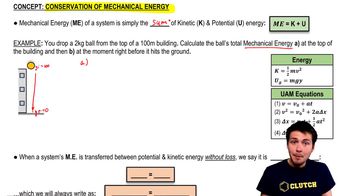
The principle of conservation of energy states that the total energy in a closed system remains constant. In this scenario, the gravitational potential energy of the sphere at the top of the incline is converted into translational and rotational kinetic energy as it rolls down. This relationship allows us to equate the initial potential energy to the sum of the translational and rotational energies at the bottom.
Recommended video:
Guided course
06:24
Conservation Of Mechanical Energy

Moment of Inertia

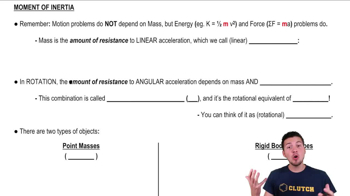
The moment of inertia is a measure of an object's resistance to changes in its rotational motion. For a solid sphere, the moment of inertia is given by the formula I = (2/5)mr², where m is the mass and r is the radius. This concept is crucial for calculating the rotational kinetic energy of the sphere as it rolls down the incline.
Recommended video:
Guided course
11:47
Intro to Moment of Inertia

Rolling Without Slipping

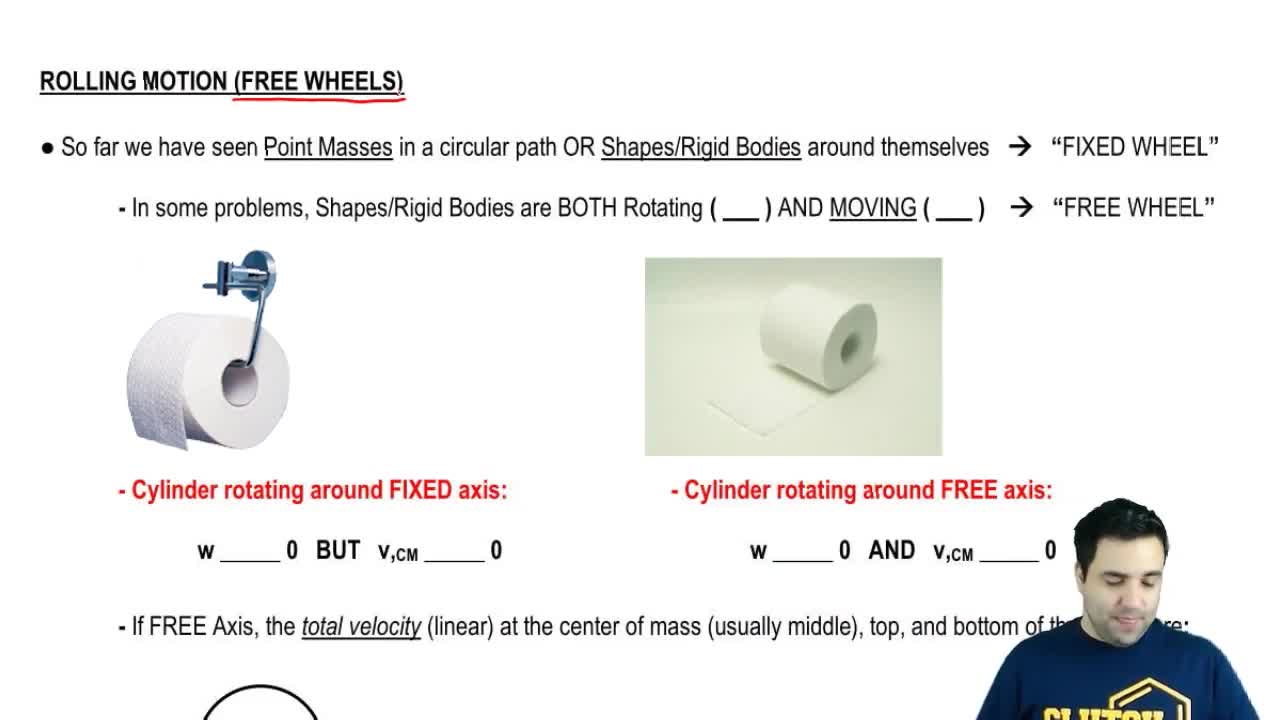
Rolling without slipping means that the point of contact between the sphere and the incline does not slide. This condition relates the translational speed (v) of the center of mass to the angular speed (ω) of the sphere through the equation v = rω. Understanding this relationship is essential for determining both the translational and rotational speeds of the sphere at the bottom of the incline.
Recommended video:
Guided course
08:47
Rolling Motion (Free Wheels)