Ch. 10 - Rotational Motion
Giancoli Douglas - Physics for Scientists and Engineers 5th edition
Giancoli Douglas5th editionPhysics for Scientists and EngineersISBN: 9780137488179Not the one you use?Change textbook
Chapter 10, Problem 73b

A solid rubber ball rests on the floor of a railroad car when the car begins moving with acceleration a. Assuming the ball rolls without slipping, what is its acceleration relative to the ground?

Verified step by step guidance
1
Identify the forces acting on the ball: The ball experiences a static friction force from the floor of the railroad car, which prevents it from slipping. This friction force is responsible for both the translational and rotational motion of the ball.
Apply Newton's second law for translational motion: The net force acting on the ball in the horizontal direction is the static friction force \( F_f \). Using \( F = ma \), we can write \( F_f = m a_{ball} \), where \( a_{ball} \) is the acceleration of the ball relative to the ground.
Apply the rotational dynamics equation: The torque caused by the static friction force \( F_f \) about the center of the ball is \( \tau = F_f R \), where \( R \) is the radius of the ball. Using the rotational analog of Newton's second law, \( \tau = I \alpha \), where \( I \) is the moment of inertia of the ball and \( \alpha \) is its angular acceleration, we can write \( F_f R = I \alpha \).
Relate angular acceleration to linear acceleration: For rolling without slipping, the angular acceleration \( \alpha \) and the linear acceleration \( a_{ball} \) are related by \( \alpha = \frac{a_{ball}}{R} \). Substitute this into the rotational dynamics equation to express \( F_f \) in terms of \( a_{ball} \).
Combine the equations: Use the expressions for \( F_f \) from both the translational and rotational dynamics equations to solve for \( a_{ball} \) in terms of the acceleration of the railroad car \( a \). The result will show how the ball's acceleration relative to the ground depends on the car's acceleration and the ball's physical properties (e.g., its moment of inertia).

Verified video answer for a similar problem:

This video solution was recommended by our tutors as helpful for the problem above.
Video duration:
10m
Was this helpful?

Key Concepts

Here are the essential concepts you must grasp in order to answer the question correctly.

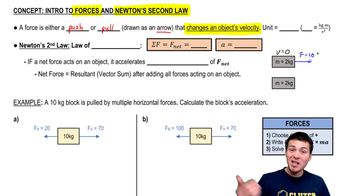
Newton's Second Law of Motion

Newton's Second Law states that the acceleration of an object is directly proportional to the net force acting on it and inversely proportional to its mass. This principle is crucial for understanding how forces affect the motion of the rubber ball as the railroad car accelerates. The net force acting on the ball will determine its acceleration relative to the ground.
Recommended video:
Guided course
06:54
Intro to Forces & Newton's Second Law

Rolling Motion

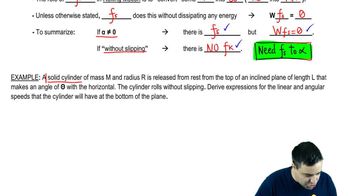
Rolling motion occurs when an object rotates about an axis while translating along a surface. For the rubber ball, rolling without slipping means that the point of contact with the ground does not slide. This concept is essential for analyzing the relationship between the ball's linear acceleration and its angular acceleration as it rolls in the accelerating railroad car.
Recommended video:
Guided course
12:26
Conservation of Energy in Rolling Motion

Relative Motion

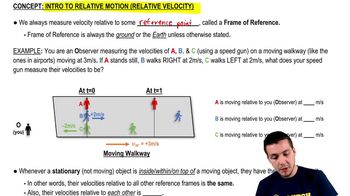
Relative motion refers to the calculation of the motion of an object as observed from a particular reference frame. In this scenario, understanding the ball's acceleration relative to the ground involves considering both the acceleration of the railroad car and the ball's own motion. This concept helps in determining how the ball's acceleration appears to an observer on the ground.
Recommended video:
Guided course
04:27
Intro to Relative Motion (Relative Velocity)
Related Practice
Textbook Question

The 1100-kg mass of a car includes four tires, each of mass 35 kg (including wheels) and diameter 0.80 m. Assume each tire and wheel combination acts as a solid cylinder. Determine the total kinetic energy of the car when traveling 95 km/h.

18
views
Textbook Question

A bowling ball of mass 7.3 kg and radius 9.0 cm rolls without slipping down a lane at 3.7 m/s. Calculate its total kinetic energy.

Textbook Question

On a 12.0-cm-diameter audio compact disc (CD), digital bits of information are encoded sequentially along an outward spiraling path. The spiral starts at radius R₁ = 2.5 cm and winds its way out to radius R₂ = 5.8 cm. To read the digital information, a CD player rotates the CD so that the player’s readout laser scans along the spiral’s sequence of bits at a constant linear speed of 1.25 m/s. Thus the player must accurately adjust the rotational frequency ƒ of the CD as the laser moves outward. Determine the values for ƒ (in units of rpm) when the laser is located at R₁ and when it is at R₂.

3
views
Textbook Question

A solid rubber ball rests on the floor of a railroad car when the car begins moving with acceleration a. Assuming the ball rolls without slipping, what is its acceleration relative to the car?

2
views
Textbook Question

The 1100-kg mass of a car includes four tires, each of mass 35 kg (including wheels) and diameter 0.80 m. Assume each tire and wheel combination acts as a solid cylinder. Determine the fraction of the kinetic energy in the tires and wheels.

11
views
Textbook Question

II) A uniform solid sphere of radius r0 = 24.5 cm and mass m = 1.60 kg starts from rest and rolls without slipping down a 30.0° incline that is 10.0 m long. Calculate its translational and rotational speeds when it reaches the bottom. Avoid putting in numbers until the end so you can answer.

1
views