
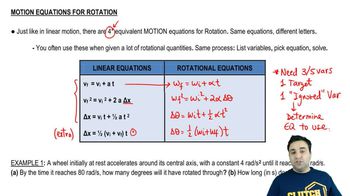
A cyclist accelerates from rest at a rate of 1.00 m/s². How fast will a point at the top of the rim of the tire (diameter = 68.0 cm) be moving after 2.75 s? [Hint: At any moment, the lowest point on the tire is in contact with the ground and is at rest—see Fig. 10–69.]
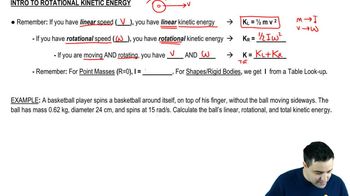
The 1100-kg mass of a car includes four tires, each of mass 35 kg (including wheels) and diameter 0.80 m. Assume each tire and wheel combination acts as a solid cylinder. Determine the total kinetic energy of the car when traveling 95 km/h.
Verified step by step guidance
Verified video answer for a similar problem:
Key Concepts
Kinetic Energy
Translational vs. Rotational Motion
Solid Cylinder Moment of Inertia
On a 12.0-cm-diameter audio compact disc (CD), digital bits of information are encoded sequentially along an outward spiraling path. The spiral starts at radius R₁ = 2.5 cm and winds its way out to radius R₂ = 5.8 cm. To read the digital information, a CD player rotates the CD so that the player’s readout laser scans along the spiral’s sequence of bits at a constant linear speed of 1.25 m/s. Thus the player must accurately adjust the rotational frequency ƒ of the CD as the laser moves outward. Determine the values for ƒ (in units of rpm) when the laser is located at R₁ and when it is at R₂.
A solid rubber ball rests on the floor of a railroad car when the car begins moving with acceleration a. Assuming the ball rolls without slipping, what is its acceleration relative to the car?
The 1100-kg mass of a car includes four tires, each of mass 35 kg (including wheels) and diameter 0.80 m. Assume each tire and wheel combination acts as a solid cylinder. Determine the fraction of the kinetic energy in the tires and wheels.
A solid rubber ball rests on the floor of a railroad car when the car begins moving with acceleration a. Assuming the ball rolls without slipping, what is its acceleration relative to the ground?
II) A uniform solid sphere of radius r0 = 24.5 cm and mass m = 1.60 kg starts from rest and rolls without slipping down a 30.0° incline that is 10.0 m long. Calculate its translational and rotational speeds when it reaches the bottom. Avoid putting in numbers until the end so you can answer.
