


Ch 34: Ray Optics
Knight Calc - Physics for Scientists and Engineers 5th Edition
Knight Calc5th EditionPhysics for Scientists and EngineersISBN: 9780137344796Not the one you use?Change textbook
Chapter 34, Problem 82a

A fortune teller's 'crystal ball' (actually just glass) is 10 cm in diameter. Her secret ring is placed 6.0 cm from the edge of the ball. An image of the ring appears on the opposite side of the crystal ball. How far is the image from the center of the ball?

Verified step by step guidance
1
The problem involves refraction through a spherical glass object. Start by identifying the relevant parameters: the diameter of the crystal ball is 10 cm, so its radius (R) is 5 cm. The ring is placed 6.0 cm from the edge of the ball, which means its distance from the center of the ball (object distance, s) is 6.0 cm + 5.0 cm = 11.0 cm.
The crystal ball can be treated as a spherical lens. Use the lensmaker's equation for a spherical refracting surface: \(\frac{n_2}{s'}\) - \(\frac{n_1}{s}\) = \(\frac{n_2 - n_1}{R}\), where n_1 is the refractive index of air (approximately 1.0), n_2 is the refractive index of glass (approximately 1.5), s is the object distance, s' is the image distance, and R is the radius of curvature of the spherical surface.
Substitute the known values into the lensmaker's equation. For the first refracting surface (the front surface of the ball), use \(\frac{1.5}{s'}\) - \(\frac{1.0}{11.0}\) = \(\frac{1.5 - 1.0}{5.0}\). Solve this equation for s', the image distance from the first surface.
The image formed by the first surface acts as the object for the second refracting surface (the back surface of the ball). Calculate the new object distance for the second surface by considering the geometry of the ball. Then, apply the lensmaker's equation again for the second surface to find the final image distance from the center of the ball.
Combine the results from both surfaces to determine the total distance of the image from the center of the ball. Ensure that the signs of the distances are consistent with the chosen coordinate system (e.g., positive for distances measured in the direction of light propagation).

Verified video answer for a similar problem:

This video solution was recommended by our tutors as helpful for the problem above.
Was this helpful?

Key Concepts

Here are the essential concepts you must grasp in order to answer the question correctly.

Refraction of Light

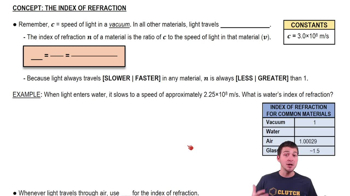
Refraction is the bending of light as it passes from one medium to another, caused by a change in its speed. In the context of a glass crystal ball, light rays entering the ball from the ring will bend at the interface between air and glass, affecting the perceived position of the image formed on the opposite side.
Recommended video:
Guided course
03:46
Index of Refraction

Lens Formula

The lens formula relates the object distance (u), image distance (v), and focal length (f) of a lens or spherical surface. For a spherical surface like a crystal ball, the formula can be adapted to find the image distance based on the object distance and the radius of curvature, which is half the diameter of the ball.
Recommended video:
05:38
Lens Maker Equation

Image Formation

Image formation refers to how light rays converge or diverge to create a visual representation of an object. In this scenario, the position of the image of the ring is determined by the geometry of the crystal ball and the distances involved, leading to the calculation of how far the image is from the center of the ball.
Recommended video:
05:51
Refraction at Spherical Surfaces
Related Practice
Textbook Question

The mirror in FIGURE CP34.79 is covered with a piece of glass whose thickness at the center equals the mirror's radius of curvature. A point source of light is outside the glass. How far from the mirror is the image of this source?

1
views
Textbook Question

CALC FIGURE CP34.81 shows a light ray that travels from point A to point B. The ray crosses the boundary at position x, making angles θ1 and θ2 in the two media. Suppose that you did not know Snell's law. You've proven that Snell's law is equivalent to the statement that 'light traveling between two points follows the path that requires the shortest time.' This interesting way of thinking about refraction is called Fermat's principle. Write an expression for the time t it takes the light ray to travel from A to B. Your expression should be in terms of the distances a, b, and w; the variable x; and the indices of refraction n1 and n2.

1
views
Textbook Question

A fortune teller's 'crystal ball' (actually just glass) is 10 cm in diameter. Her secret ring is placed 6.0 cm from the edge of the ball. The crystal ball is removed and a thin lens is placed where the center of the ball had been. If the image is still in the same position, what is the focal length of the lens?

1
views
Textbook Question

Consider a lens having index of refraction n₂ and surfaces with radii R₁ and R₂. The lens is immersed in a fluid that has index of refraction n₁. A symmetric converging glass lens (i.e., two equally curved surfaces) has two surfaces with radii of 40 cm. Find the focal length of this lens in air and the focal length of this lens in water.

1
views