

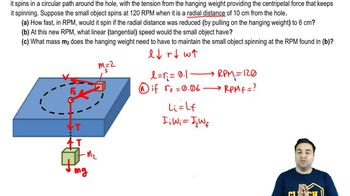
The mirror in FIGURE CP34.79 is covered with a piece of glass whose thickness at the center equals the mirror's radius of curvature. A point source of light is outside the glass. How far from the mirror is the image of this source?
Consider a lens having index of refraction n₂ and surfaces with radii R₁ and R₂. The lens is immersed in a fluid that has index of refraction n₁. A symmetric converging glass lens (i.e., two equally curved surfaces) has two surfaces with radii of 40 cm. Find the focal length of this lens in air and the focal length of this lens in water.
Verified step by step guidance
Verified video answer for a similar problem:
Key Concepts
Lens Maker's Formula
Index of Refraction
Focal Length
CALC FIGURE CP34.81 shows a light ray that travels from point A to point B. The ray crosses the boundary at position x, making angles θ1 and θ2 in the two media. Suppose that you did not know Snell's law. You've proven that Snell's law is equivalent to the statement that 'light traveling between two points follows the path that requires the shortest time.' This interesting way of thinking about refraction is called Fermat's principle. Write an expression for the time t it takes the light ray to travel from A to B. Your expression should be in terms of the distances a, b, and w; the variable x; and the indices of refraction n1 and n2.
Some electro-optic materials can change their index of refraction in response to an applied voltage. Suppose a plano-convex lens (flat on one side, a 15.0 cm radius of curvature on the other), made from a material whose normal index of refraction is 1.500, is creating an image of an object that is 50.0 cm from the lens. By how much would the index of refraction need to be increased to move the image 5.0 cm closer to the lens?
A fortune teller's 'crystal ball' (actually just glass) is 10 cm in diameter. Her secret ring is placed 6.0 cm from the edge of the ball. The crystal ball is removed and a thin lens is placed where the center of the ball had been. If the image is still in the same position, what is the focal length of the lens?
A 2.0-cm-tall object is placed in front of a mirror. A 1.0-cm-tall upright image is formed behind the mirror, 150 cm from the object. What is the focal length of the mirror?
A fortune teller's 'crystal ball' (actually just glass) is 10 cm in diameter. Her secret ring is placed 6.0 cm from the edge of the ball. An image of the ring appears on the opposite side of the crystal ball. How far is the image from the center of the ball?
