
Ch 34: Ray Optics
Knight Calc - Physics for Scientists and Engineers 5th Edition
Knight Calc5th EditionPhysics for Scientists and EngineersISBN: 9780137344796Not the one you use?Change textbook
Chapter 34, Problem 81a

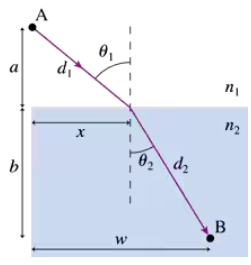
CALC FIGURE CP34.81 shows a light ray that travels from point A to point B. The ray crosses the boundary at position x, making angles θ1 and θ2 in the two media. Suppose that you did not know Snell's law. You've proven that Snell's law is equivalent to the statement that 'light traveling between two points follows the path that requires the shortest time.' This interesting way of thinking about refraction is called Fermat's principle. Write an expression for the time t it takes the light ray to travel from A to B. Your expression should be in terms of the distances a, b, and w; the variable x; and the indices of refraction n1 and n2.

Verified step by step guidance
1
Step 1: Begin by understanding Fermat's principle, which states that light travels between two points along the path that requires the shortest time. To calculate the total time t, we need to sum the time taken by the light ray in each medium.
Step 2: The time taken by light to travel a distance d in a medium is given by t = d / v, where v is the speed of light in that medium. The speed of light in a medium is related to the index of refraction n by v = c / n, where c is the speed of light in a vacuum. Thus, t = n * d / c.
Step 3: In the first medium (with index of refraction n1), the distance traveled by the light ray is d1. Using trigonometry, d1 can be expressed as d1 = sqrt(a^2 + x^2). The time taken in the first medium is t1 = n1 * d1 / c = n1 * sqrt(a^2 + x^2) / c.
Step 4: In the second medium (with index of refraction n2), the distance traveled by the light ray is d2. Using trigonometry, d2 can be expressed as d2 = sqrt(b^2 + (w - x)^2). The time taken in the second medium is t2 = n2 * d2 / c = n2 * sqrt(b^2 + (w - x)^2) / c.
Step 5: Combine the times from both media to write the total time t. The total time is t = t1 + t2 = (n1 * sqrt(a^2 + x^2) / c) + (n2 * sqrt(b^2 + (w - x)^2) / c). This is the expression for the time it takes the light ray to travel from A to B.

Verified video answer for a similar problem:

This video solution was recommended by our tutors as helpful for the problem above.
Was this helpful?

Key Concepts

Here are the essential concepts you must grasp in order to answer the question correctly.

Snell's Law

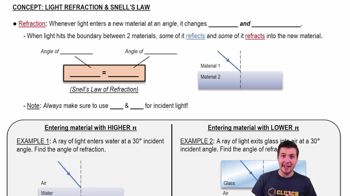
Snell's Law describes how light refracts when it passes between two different media. It states that the ratio of the sines of the angles of incidence and refraction is equal to the ratio of the indices of refraction of the two media. Mathematically, it is expressed as n1 * sin(θ1) = n2 * sin(θ2), where n1 and n2 are the indices of refraction, and θ1 and θ2 are the angles of incidence and refraction, respectively.
Recommended video:

Fermat's Principle

Fermat's Principle posits that light travels between two points along the path that takes the least time. This principle can be used to derive Snell's Law and provides a conceptual framework for understanding refraction. By applying this principle, one can analyze the time taken for light to traverse different paths and determine the optimal route based on the varying speeds of light in different media.
Recommended video:
Guided course
14:47
Diffraction with Huygen's Principle

Optical Path Length

The optical path length is a concept that combines the physical distance light travels with the refractive index of the medium. It is defined as the product of the distance traveled in a medium and the refractive index of that medium. In the context of the question, the total time taken for light to travel from point A to B can be expressed in terms of the distances a, b, and w, and the indices of refraction n1 and n2, allowing for the calculation of the shortest time path.
Recommended video:
Guided course
08:20
Mean Free Path