Ch 12: Rotation of a Rigid Body
Knight Calc - Physics for Scientists and Engineers 5th Edition
Knight Calc5th EditionPhysics for Scientists and EngineersISBN: 9780137344796Not the one you use?Change textbook
Chapter 12, Problem 17b

A 12-cm-diameter DVD has a mass of 21 g. What is the DVD's moment of inertia for rotation about a perpendicular axis through the edge of the disk?

Verified step by step guidance
1
Step 1: Identify the shape of the object and the axis of rotation. The DVD is a disk, and the axis of rotation is perpendicular to the disk and passes through its edge. This requires using the parallel axis theorem to calculate the moment of inertia.
Step 2: Write the formula for the moment of inertia of a disk about its center of mass. The formula is \( I_{center} = \frac{1}{2} m r^2 \), where \( m \) is the mass of the disk and \( r \) is its radius.
Step 3: Convert the given values into SI units. The diameter of the DVD is 12 cm, so the radius \( r \) is \( 6 \, \text{cm} = 0.06 \, \text{m} \). The mass \( m \) is \( 21 \, \text{g} = 0.021 \, \text{kg} \).
Step 4: Apply the parallel axis theorem to find the moment of inertia about the edge. The theorem states \( I_{edge} = I_{center} + m d^2 \), where \( d \) is the distance from the center of mass to the new axis. For this problem, \( d \) is equal to the radius \( r \).
Step 5: Substitute the values into the formulas. First calculate \( I_{center} \) using \( \frac{1}{2} m r^2 \), then calculate \( m d^2 \), and finally add these two terms together to find \( I_{edge} \).

Verified video answer for a similar problem:

This video solution was recommended by our tutors as helpful for the problem above.
Video duration:
5m
Was this helpful?

Key Concepts

Here are the essential concepts you must grasp in order to answer the question correctly.

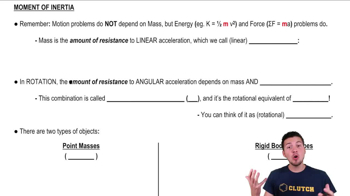
Moment of Inertia

Moment of inertia is a measure of an object's resistance to changes in its rotational motion. It depends on the mass distribution relative to the axis of rotation. For a solid disk, the moment of inertia can be calculated using the formula I = (1/2) m r², where m is the mass and r is the radius. This concept is crucial for understanding how mass affects rotational dynamics.
Recommended video:
Guided course
11:47
Intro to Moment of Inertia

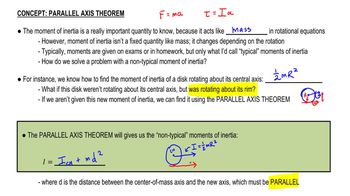
Parallel Axis Theorem

The parallel axis theorem allows us to calculate the moment of inertia of a body about any axis parallel to an axis through its center of mass. It states that I = I_cm + md², where I_cm is the moment of inertia about the center of mass, m is the mass, and d is the distance between the two axes. This theorem is essential for solving the problem since the axis of rotation is not through the center of the DVD.
Recommended video:
Guided course
13:46
Parallel Axis Theorem

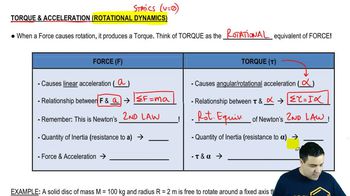
Rotational Dynamics

Rotational dynamics is the study of the effects of forces and torques on the motion of rotating bodies. It encompasses concepts such as angular momentum, torque, and the relationship between linear and angular quantities. Understanding rotational dynamics is vital for analyzing how the DVD will behave when subjected to rotational forces, particularly in calculating its moment of inertia.
Recommended video:
Guided course
08:12
Torque & Acceleration (Rotational Dynamics)